
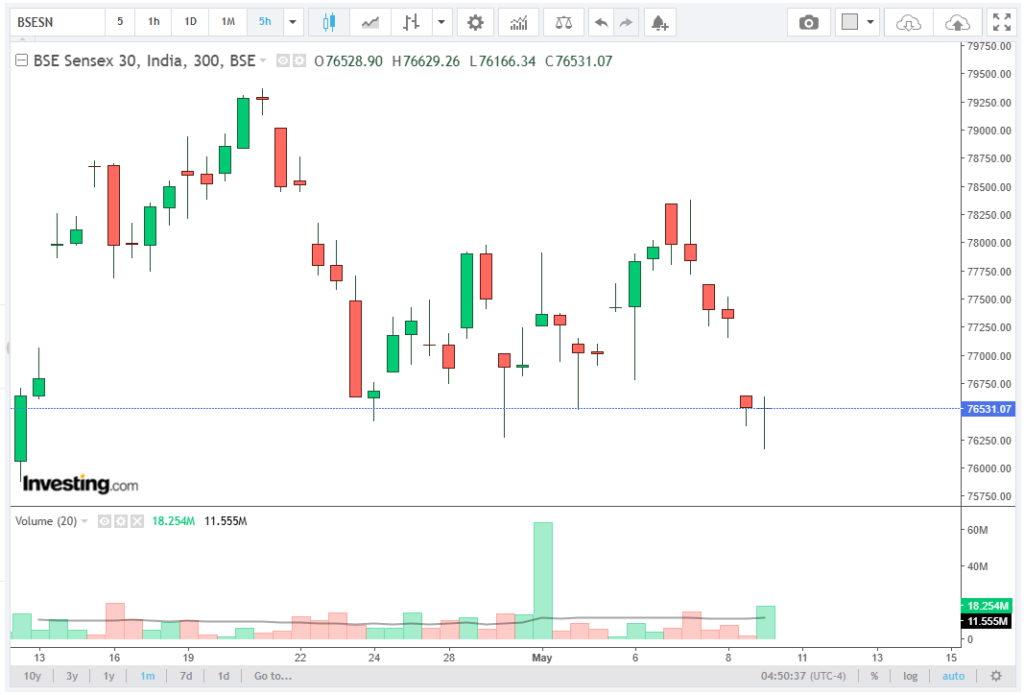
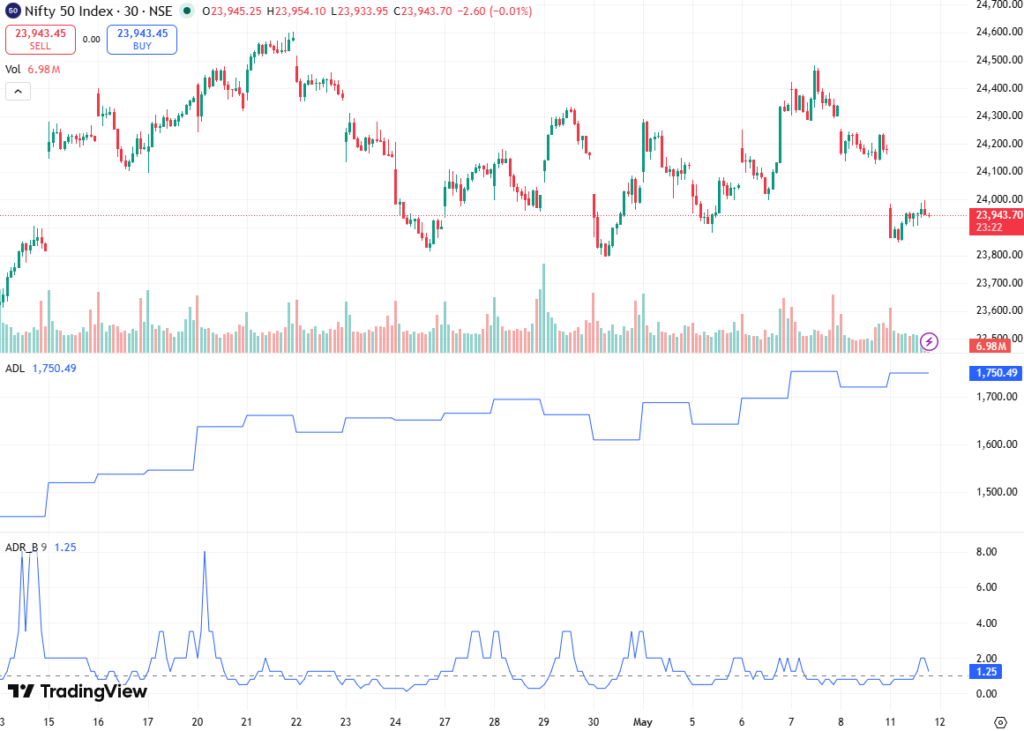
The Indian stock market opened the week on a weak note, as both benchmark indices traded in the red amid weak global cues and rising crude oil prices. The BSE Sensex fell 1,047.57 points (1.35%) to 76,280.62, while the Nifty50 slipped 301.85 points (1.25%) to 23,874.75.
Investor sentiment remained cautious throughout the session, with selling pressure observed across multiple sectors, particularly consumer durables, auto, media, and realty stocks. The brokers at Rubizio examine this topic from every angle in this insightful article.
Global Weakness Hurts Domestic Market
Global market volatility significantly influenced Indian equities at the start of the week. Fresh geopolitical tensions in West Asia fueled concerns over supply disruptions, pushing Brent crude above $104 per barrel. The Brent crude futures contract rose 3.31% to $104.64 per barrel after the US President rejected Iran’s latest proposal to end hostilities in the region.
Rising crude oil prices exacerbate import costs for oil-dependent economies such as India and raise inflationary pressures, directly affecting sectors like aviation, paints, logistics, and automobiles. Consequently, investors adopted a risk-averse approach, reducing exposure to volatile stocks.
Heavy Selling in Large-Cap Stocks
Large-cap companies faced substantial selling pressure, dragging benchmark indices lower. Notable Nifty50 losers included Titan Company, InterGlobe Aviation, and State Bank of India.
Titan Company declined as investors became cautious toward consumer spending stocks. InterGlobe Aviation suffered due to rising fuel costs caused by higher crude prices. State Bank of India fell amid broader banking sector weakness.
Market experts highlighted that profit booking after recent gains, combined with valuation concerns and global uncertainty, curbed fresh buying interest.
Midcap and Smallcap Stocks Also Remain Weak
The broader market mirrored the weakness in frontline indices, with midcap and smallcap stocks witnessing selling across sectors. The Nifty MidCap index fell 1.15%, while the Nifty SmallCap index declined 1.40%.
This broader market weakness reflects low risk appetite among investors amid geopolitical uncertainty. Retail investors, who often favor small-cap and mid-cap stocks in bullish markets, tend to retreat during global volatility, leading to sharper corrections in these segments.
Consumer Durable Sector Faces Sharp Decline
Among sectoral indices, the Nifty Consumer Durable index recorded the steepest decline, as weak discretionary spending sentiment affected this sector significantly. Other underperforming sectors included Nifty Media, Nifty Auto, and Nifty Realty.
Rising oil prices pressured automobile and aviation companies, while economic caution weighed on media and real estate shares.
On the flip side, the Nifty IT index emerged as a top performer, driven by expectations of stable global demand and defensive strength. Information technology stocks often attract investor interest during uncertain market conditions, given their export revenue and resilient business models.
Global Fund Flows Influence Market Direction
Foreign institutional investors (FIIs) and foreign portfolio investors (FPIs) continue to play a key role in market sentiment. On days of heightened global uncertainty, these investors often reduce exposure to emerging markets, including India, leading to selling pressure in equities.
Conversely, inflows from domestic mutual funds sometimes provide partial support, particularly in defensive sectors like IT, FMCG, and healthcare. Analysts note that sustained volatility in crude oil and geopolitical developments may keep foreign fund flows volatile, influencing both short-term trends and liquidity in the broader market.
Focus Shifts to Fourth-Quarter Earnings
Investors are closely watching Q4 earnings, which guide both stock-specific moves and broader market trends amid global economic uncertainty. Quarterly results serve as a barometer of corporate resilience, influencing short-term trades and medium-term investment strategies.
The banking sector draws attention to loan growth, asset quality, net interest margins (NIMs), and provisions, with deviations often impacting large-cap stocks and indexes. Pharmaceuticals are scrutinized for revenue, exports, and regulatory approvals, while rising crude prices put auto companies under pressure on margins, demand, pricing, and inventory.
Energy firms, across oil, renewables, and power, signal production efficiency, cost management, and capacity expansion, potentially offsetting or amplifying market volatility. Hospitality and tourism are evaluated for occupancy, revenues, and cost control, with post-pandemic recovery shaping sectoral performance.
Investor focus also extends to management commentary on growth, margins, and capital expenditure, as clear guidance attracts buying, while vague outlooks trigger short-term corrections.
Overall, earnings season acts as a market compass, helping investors navigate economic uncertainty, sector-specific risks, and crude price volatility, prioritizing stocks with strong fundamentals, steady cash flows, and defensive business models.
Investors Stay Careful Amid Uncertainty
The overall market sentiment is cautious, shaped by geopolitical tensions, high crude prices, and weak international cues. Traders prefer selective buying rather than aggressive positions, anticipating continued volatility until global clarity emerges.
Domestic investors are watching quarterly earnings and foreign fund flows closely. While strong corporate results could provide support, further crude price hikes may add pressure.


