
The Indian Rupee (INR) found renewed support on Wednesday as global crude oil prices declined, easing pressure on India’s external balances and improving short-term sentiment toward the currency.
The USD/INR pair traded largely flat near 92.30, after trimming earlier losses as market participants digested reports that the International Energy Agency (IEA) may release record volumes of oil reserves to stabilize energy markets. The brokers at Byronixel share their comprehensive insights on this topic in this article.
Lower energy prices are particularly beneficial for India because the country remains one of the world’s largest oil importers, relying heavily on external supply to meet domestic demand. Consequently, even modest changes in crude prices can significantly influence India’s current account balance, inflation outlook, and currency stability.
Market participants are also closely watching whether the Reserve Bank of India (RBI) may intervene in foreign exchange markets to limit excessive volatility in the rupee.
IEA Oil Reserve Release: A Major Potential Market Catalyst
Recent reports suggest that the IEA is considering a strategic release of oil reserves that could surpass the historic 182 million barrel drawdown implemented in 2022 following Russia’s invasion of Ukraine. If executed, this would represent the largest coordinated oil reserve release in modern history.
Such a move is designed to increase global oil supply temporarily, dampen speculative price spikes, and provide a short-term buffer against geopolitical disruptions. The decision comes amid heightened concerns surrounding escalating tensions in the Middle East, particularly the Israel–US conflict with Iran, which has raised fears of supply interruptions.
Oil Market Dynamics and the Strait of Hormuz Risk
Despite the recent decline, downside risks for oil prices remain limited due to ongoing geopolitical uncertainties. West Texas Intermediate (WTI) crude was trading around $82.30 per barrel during Asian trading hours, retreating slightly from the previous session’s highs.
However, markets remain cautious because of the strategic importance of the Strait of Hormuz, a critical maritime route through which nearly one-fifth of global oil supply passes. Any shipping disruption or military escalation in the region could rapidly reverse the current decline in oil prices.
The potential for supply chain disruptions, sanctions, or maritime blockades continues to influence crude markets. As a result, energy traders are pricing in a geopolitical risk premium, which may limit how far prices can fall even if the IEA releases additional reserves.
For the Indian economy, this creates a delicate balancing act: while lower prices are supportive for the rupee, any sudden supply shock could quickly reignite inflation pressures and weaken the currency.
US Dollar Dynamics and Safe-Haven Demand
While the rupee has benefited from lower oil prices, the US Dollar (USD) may regain strength if safe-haven demand increases amid escalating geopolitical risks.
Uncertainty surrounding the Middle East conflict remains elevated. Although the US President suggested earlier in the week that the situation could end soon, reports from US officials indicate that military operations in Iran are intensifying, with limited prospects for near-term diplomatic negotiations.
Periods of geopolitical instability often trigger risk-off sentiment in global markets, leading investors to shift capital into traditional safe-haven assets such as the US Dollar and US Treasury bonds.
If this trend accelerates, it could offset some of the rupee’s gains from lower oil prices, creating a more complex outlook for the USD/INR exchange rate.
Technical Analysis: USD/INR Maintains Bullish Structure
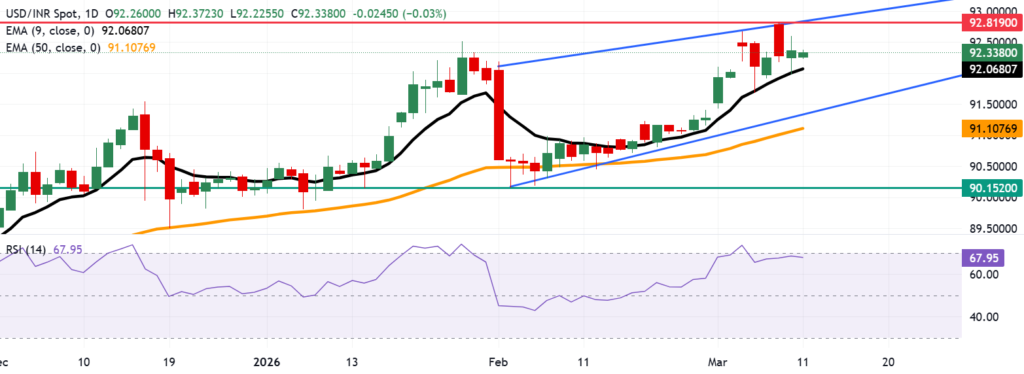
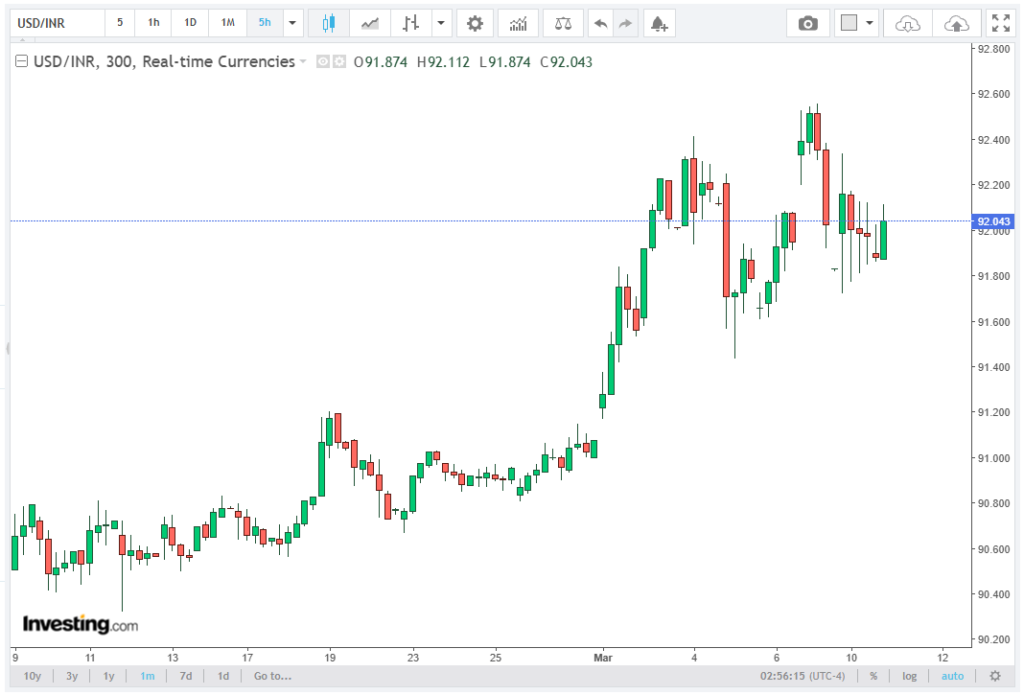
From a technical perspective, the USD/INR pair continues to show a bullish bias, despite recent consolidation. The pair remains within a well-defined ascending channel on the daily chart, indicating that the broader uptrend remains intact.
Currently trading around 92.30, the pair sits slightly below the previous close but remains above several key technical indicators.
The nine-day Exponential Moving Average (EMA) is positioned near 92.06, providing immediate support for the currency pair. Meanwhile, the 50-day EMA continues to slope upward, reinforcing the longer-term bullish trend.
Momentum indicators also remain constructive. The 14-day Relative Strength Index (RSI) is hovering in the mid-60s, indicating positive but not overextended buying pressure. This suggests that while bullish sentiment persists, the market has not yet reached overbought territory.
Conclusion
The Indian Rupee’s recent stability reflects a combination of lower crude oil prices, shifting monetary policy expectations, and global geopolitical developments. Reports that the IEA may release record oil reserves have helped ease pressure on energy markets, offering short-term support for the rupee.
However, the currency’s outlook remains highly sensitive to geopolitical risks, US monetary policy signals, and global commodity price movements. As traders digest upcoming US inflation data and monitor developments in the Middle East, volatility in the USD/INR pair may remain elevated in the near term.
For now, lower oil prices provide a crucial cushion for the rupee, but the broader trend will depend on global risk sentiment and the trajectory of energy markets.


