
The Indian Rupee (INR) started the week on a negative note against the US Dollar (USD), with the USD/INR pair climbing 0.5% to trade near 95.00. This depreciation results from a sharp increase in crude oil prices, driven by renewed uncertainty over a US-Iran diplomatic resolution. In this article, the brokers at Winseterra offer a comprehensive analysis of the topic.
As of writing, West Texas Intermediate (WTI) crude has surged by over 5%, trading near $96.40 per barrel. Economies like India, which rely heavily on oil imports to meet their energy requirements, often see their currencies weaken when oil prices rise sharply. Higher crude costs typically widen the trade deficit, raise inflation expectations, and put pressure on the domestic currency.
Concurrently, the US Dollar Index (DXY), which measures the Greenback against six major currencies, trades 0.3% higher near 98.10, reflecting the market’s anticipation that the Federal Reserve (Fed) may maintain current interest rates through the year-end.
Iran Demands Sovereignty Over the Strait of Hormuz
The geopolitical tension stems from Iran’s insistence on recognition of its sovereignty near the Strait of Hormuz. According to the US President’s statement, Tehran’s stance includes taxation rights on maritime traffic, compensation for war damages, the release of frozen Iranian assets, and the lifting of international sanctions.
The Strait of Hormuz is a critical oil transit chokepoint, through which nearly 20% of global crude passes. Any move by Iran to assert control or levy charges could trigger further volatility in global oil markets, directly affecting oil-importing countries like India.
The US President’s dismissal of Iran’s response has dashed hopes for a near-term resolution, leaving global markets and investors on edge. The lack of agreement signals that oil price risks remain elevated, reinforcing the strength of the US Dollar and the weakness of emerging market currencies, including the INR.
Indian PM Modi Urges Conservation Measures
The impact of rising crude prices is now being felt domestically, prompting Indian Prime Minister Narendra Modi to urge citizens to take conservative measures. PM Modi recommended reducing fuel consumption, avoiding non-essential foreign travel, and limiting gold purchases. These steps aim to preserve India’s foreign exchange reserves and curb pressure on the trade deficit amid a depreciating Rupee.
Rising oil prices exacerbate import bills, leading to currency depreciation, which in turn heightens inflationary pressures. Higher inflation can reduce household spending power, constrain economic growth, and restrict the Reserve Bank of India (RBI) from cutting interest rates in the near term.
Foreign Institutional Investors Remain Cautious
The Indian equity market has seen sustained selling pressure from Foreign Institutional Investors (FIIs), who remain net sellers amid high oil prices and geopolitical uncertainty. In early May, FIIs have sold a net of Rs. 11,072.35 crore over four out of five trading sessions.
This capital outflow not only pressures equities but also exerts downward pressure on the INR, creating a feedback loop that amplifies currency depreciation risks. Market participants continue to monitor oil price movements, US-Iran negotiations, and domestic economic data for signs of stabilization.
Technical Analysis of USD/INR
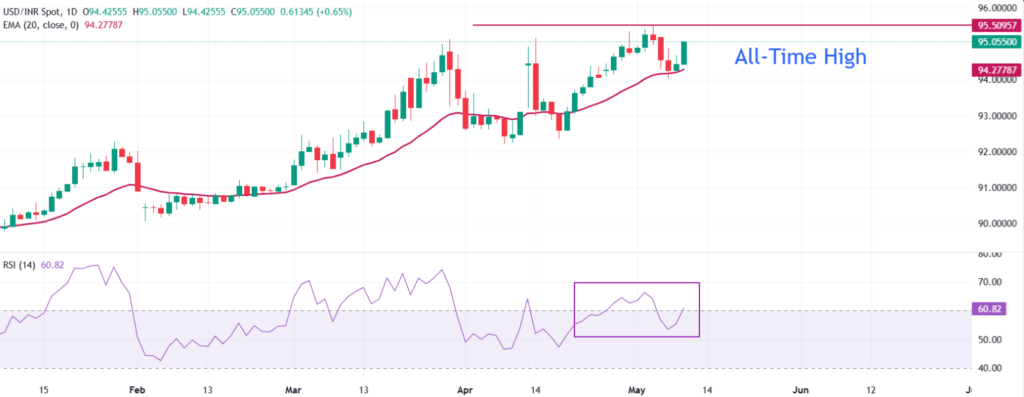
From a technical standpoint, the USD/INR pair is trading firmly near 95.00, above its 20-day exponential moving average (EMA) at 94.28, signaling a bullish near-term trend. The positive slope of the 20-day EMA reinforces trend support, while the Relative Strength Index (RSI) around 61 remains in bullish territory, suggesting upside momentum without indicating overbought conditions.
On the support side, the 20-day EMA at 94.28 serves as the first level where buyers may step in. A daily close below this level could signal short-term weakness, potentially exposing the pair to a deeper correction toward 94.00.
To the upside, the USD/INR aims to revisit the all-time high of 95.50, recorded on May 5. Sustained buying pressure and oil-induced inflationary concerns may further extend the uptrend, keeping the Rupee under pressure against the Greenback.
Outlook and Implications
The Indian Rupee’s weakness reflects a combination of external and domestic factors. On the external front, geopolitical tensions between the US and Iran are driving crude oil volatility, bolstering the US Dollar. Domestically, rising fuel costs, trade deficit pressures, and FIIs selling equities are weighing on market sentiment.
Investors should monitor oil price trends, the trajectory of US-Iran negotiations, and domestic macroeconomic indicators, including inflation and RBI policy signals. For policymakers, reducing fuel consumption, limiting non-essential imports, and maintaining currency stability remain critical in mitigating the impact of high oil prices on the Indian economy.
Conclusion
In conclusion, with oil prices near multi-month highs, the INR faces near-term downside pressure, while USD/INR technicals indicate continued bullish momentum. The Rupee’s trajectory will largely depend on geopolitical developments and domestic policy measures, highlighting the delicate balance between energy security, currency stability, and economic growth.


