
The Japanese Yen (JPY) continued its weaker trajectory against the US Dollar (USD) on Friday as markets braced for key economic data releases and eyed the Federal Reserve’s (Fed) upcoming policy decision. In this article, the brokers at Nummvix share their insights and offer a detailed explanation of the topic.
The USD/JPY pair extended its winning streak for the fourth consecutive session, trading around 159.40 during early European hours, reflecting persistent US Dollar strength amid expectations that the Fed will maintain interest rates at current levels.
USD/JPY Holds Ground as Markets Anticipate Fed Policy
Traders are closely monitoring the USD/JPY exchange rate, which remains elevated as futures markets and economists predict the Fed will keep the federal funds rate unchanged at 3.50%–3.75% in next week’s policy meeting.
Market participants are also awaiting January’s Personal Consumption Expenditures (PCE) Price Index, the Fed’s preferred inflation gauge, scheduled for later on Friday. While the PCE will not yet reflect the Iran-Israel conflict, it remains a critical inflation indicator influencing monetary policy expectations.
Alongside the PCE, investors are analyzing fourth-quarter US GDP growth data and March consumer confidence figures, which could further reinforce the USD’s resilience. As the greenback consolidates, the Japanese Yen faces sustained downward pressure, reflecting broader risk-off sentiment and geopolitical uncertainty.
Japanese Authorities Signal Readiness Amid Rising Oil Prices
Japanese Finance Minister Satsuki Katayama emphasized that authorities are prepared to take all necessary steps in currency markets to address Yen weakness, particularly as oil prices surge due to the ongoing Middle East conflict. Katayama’s statement underscores the government’s vigilance in managing potential exchange rate volatility, especially given Japan’s high import dependence on Middle Eastern oil.
Meanwhile, Bank of Japan (BoJ) Governor Kazuo Ueda highlighted that a weaker Yen could amplify imported inflation, potentially compelling the central bank to accelerate policy normalization. Ueda noted that exchange rates now have a greater influence on inflation dynamics than in the past, suggesting that currency movements have become a central consideration in monetary policy decisions.
Technical Levels and Market Observations
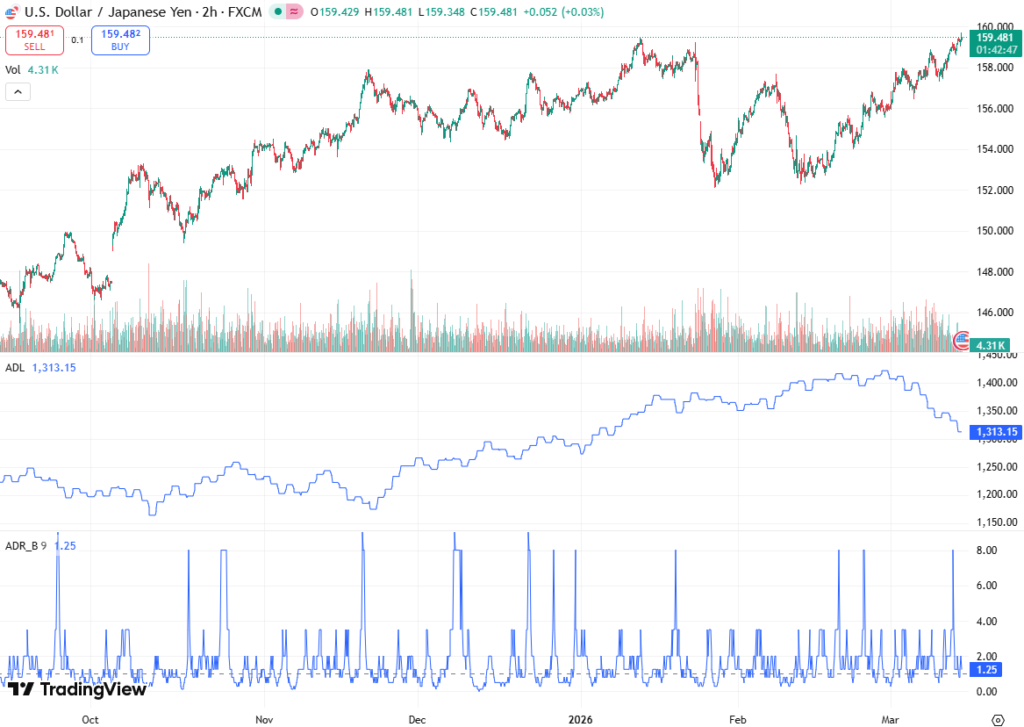
DBS Group Research strategist Chang Wei Liang commented that the USD/JPY pair is approaching the psychologically and technically significant 160 level, which has historically prompted intervention by Japanese authorities.
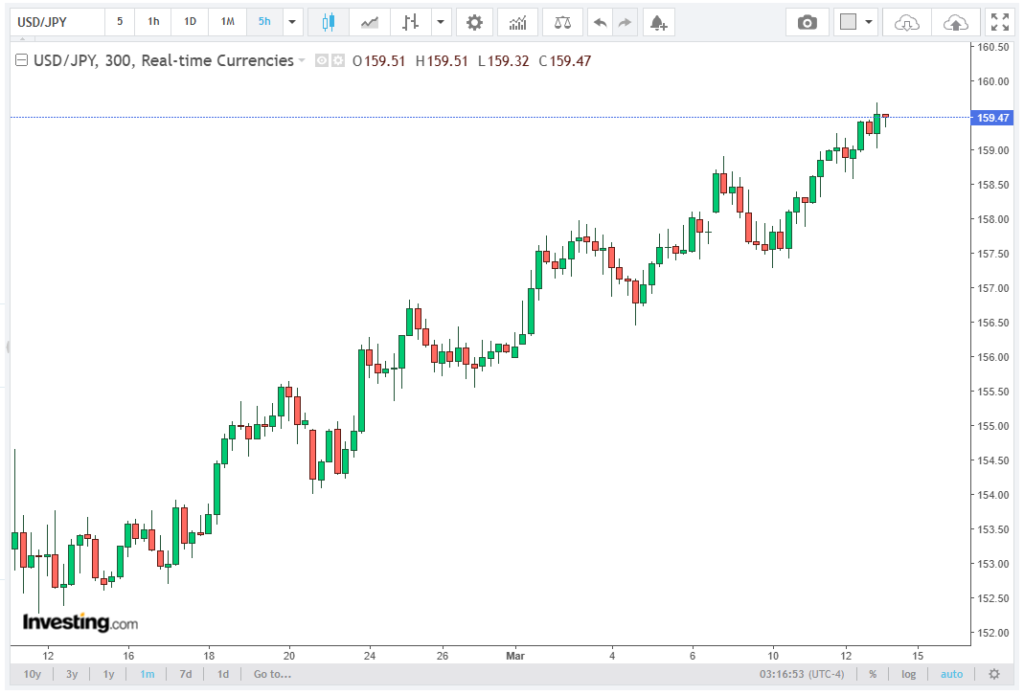
Despite the proximity to this critical threshold, officials have remained largely silent, reflecting a cautious approach. Liang added that Japan’s strategic oil reserves and strong reliance on Middle Eastern crude may allow for temporary tolerance of Yen weakness, with limited further depreciation expected in the near term.
Strategic Oil Reserve Release to Stabilize Markets
In response to global energy disruptions, Japan plans to release approximately 80 million barrels of oil from its strategic reserves, equivalent to roughly 45 days of supply. This measure is aimed at mitigating supply constraints caused by the Middle East conflict, where nearly 90% of Japan’s oil imports transit the Strait of Hormuz, now affected by Iranian control amid regional hostilities.
Prime Minister Sanae Takaichi announced that Japan will begin releasing its share from March 16, coordinating with the Group of Seven (G7) and the International Energy Agency (IEA). The move underscores Japan’s proactive stance in safeguarding energy security while supporting global market stability.
Geopolitical Tensions Amplify Yen Volatility
Ongoing geopolitical tensions in the Middle East continue to exacerbate Yen volatility, as Japan’s heavy reliance on oil imports from the region exposes the currency to supply shocks. With nearly 95% of Japan’s crude oil sourced from the Middle East and a significant portion transiting the Strait of Hormuz, any disruption, such as the United States-Israel conflict with Iran, can directly impact energy prices and, consequently, the USD/JPY exchange rate.
Traders are closely watching Japan’s strategic reserve releases and potential market interventions, which could serve as temporary buffers against sharp currency depreciation, while global investors remain sensitive to inflationary pressures transmitted through rising import costs.
Diversifying Supply Sources
Japanese Trade Minister Ryosei Akazawa highlighted ongoing discussions regarding Japan’s allocation and timing within the IEA-led coordinated oil release. Akazawa noted that Japanese companies are actively exploring alternative crude supply sources, including the United States, Central Asia, and South America, in an effort to reduce dependence on Middle Eastern imports and hedge against geopolitical disruptions.
Outlook for USD/JPY and the Yen
With the USD/JPY pair holding near 159–160, traders remain focused on both macro indicators and geopolitical developments. The upcoming PCE data, combined with US GDP and consumer confidence figures, will likely influence Fed policy expectations, while Japan’s interventions in both currency and energy markets may provide temporary support for the Yen.
Overall, the Japanese Yen remains under pressure due to a combination of strong US Dollar momentum, imported inflation risks, and rising oil prices, highlighting the interconnectedness of monetary policy, energy security, and currency markets in shaping FX trends.


