
Kalyan Jewellers Ltd faced a surprising market setback on Monday as its share price dropped 8.21% to Rs. 389.70, even after reporting stellar quarterly results for FY26. The decline came despite the company posting a 118.2% rise in net profit, highlighting the impact of macroeconomic and policy factors on investor sentiment. Rubizio’s experts deliver an in-depth explanation of this topic in the following article.
Market Reaction: Price Movements and Trading Volume
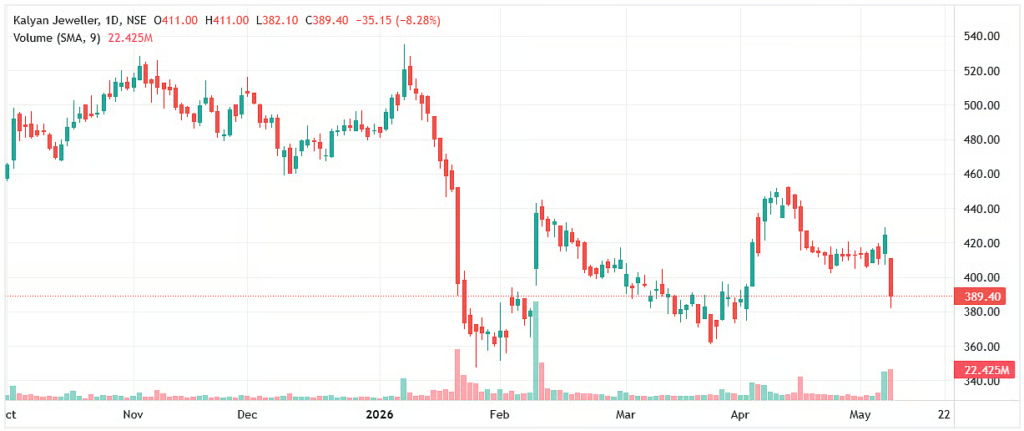
Kalyan Jewellers’ shares opened at Rs. 411, already down from the previous close of Rs. 424.55. Throughout the trading session, the stock fluctuated between a high of Rs. 411 and a low of Rs. 382.10, indicating significant intraday volatility.
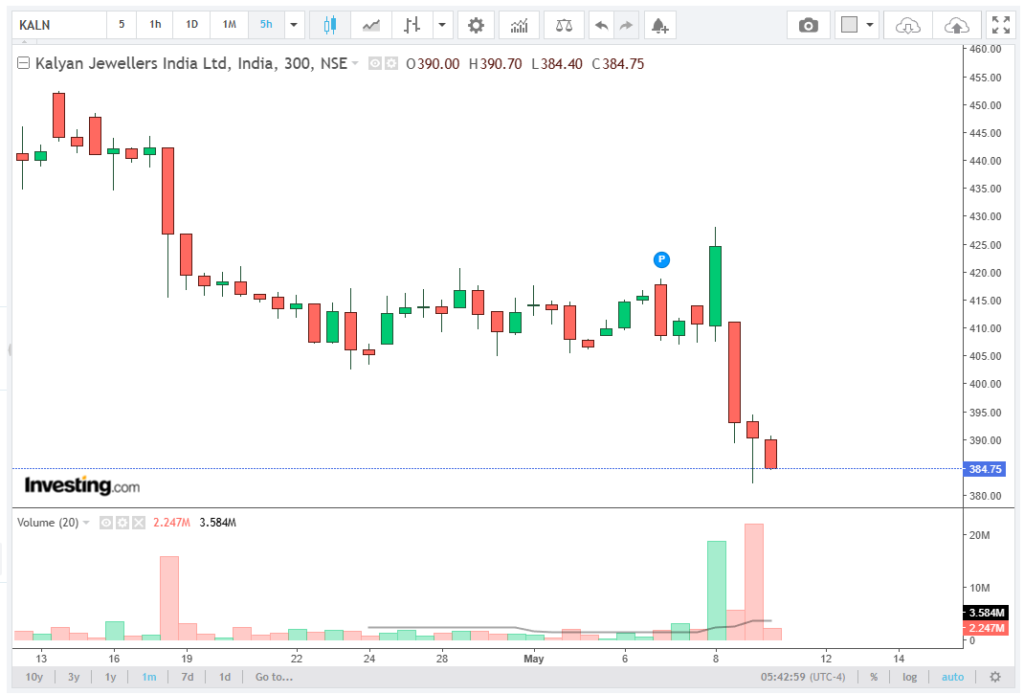
Trading activity was robust, with over 2.22 crore shares changing hands, representing a total value of Rs. 86,835.84 lacs. The Volume Weighted Average Price (VWAP) stood at Rs. 388.79, which is close to the current market price, suggesting that the majority of trades occurred at lower levels. According to Moneycontrol charts, Kalyan Jewellers experienced a loss of 8.28% during afternoon trading, signaling continued pressure on the stock.
Market Capitalization and Long-Term Performance
Despite the daily fall, the company’s market capitalization remains at Rs. 40,307 crore, reflecting its substantial presence in India’s jewellery sector. Examining the 52-week range, Kalyan Jewellers shares have fluctuated between Rs. 347.50 and Rs. 617.70, suggesting long-term resilience despite short-term setbacks.
This contrast between long-term strength and short-term volatility underscores the dual nature of stock movements: strong fundamentals can be temporarily overshadowed by macroeconomic or policy-driven concerns.
Record Q4 Growth Amid National Austerity
The recent drop in share price is particularly surprising when juxtaposed with Kalyan Jewellers’ strong Q4 FY26 performance. The company reported a net profit of Rs. 409.5 crore, up 118.2% from Rs. 187.6 crore in the same period last year. Revenue surged by 66.2%, reaching Rs. 10,274.9 crore, reflecting strong operational execution and consumer demand. The board also announced a final dividend of Rs. 2.5 per share, reinforcing the company’s commitment to shareholder returns.
However, these impressive results were overshadowed by a policy-driven development. Prime Minister Narendra Modi, during an event in Hyderabad, urged citizens to stop purchasing gold for a year to curb foreign exchange outflows.
India spends approximately $6 billion per month on gold imports, and the government is keen to reduce this burden amid the Middle East geopolitical crisis. This cautionary appeal triggered investor anxiety, as the potential softening of domestic gold demand poses a risk to the jewellery industry.
Analyst Views and Future Outlook
Despite the recent dip, brokerage firms remain optimistic about Kalyan Jewellers’ long-term prospects. Motilal Oswal maintained a ‘Buy’ rating on the stock, with a target price of Rs. 575, citing strong earnings growth, strategic franchise expansion, and geographic diversification beyond South India.
The firm projects a 22% growth in profit over the next two years, highlighting the company’s capacity to maintain robust financial performance. Currently, Kalyan Jewellers trades at a Price-to-Earnings (PE) ratio of 31.37, significantly lower than the sector PE of 65.11, indicating potential undervaluation even after the 8% intraday decline.
Analysts point out that non-South Indian markets and a franchise model could be critical levers for sustaining profitability, allowing the company to mitigate the impact of any temporary slowdown in gold demand.
Macro Impact vs. Micro Fundamentals
The 8.21% drop highlights a classic phenomenon in equity markets: macro news can overshadow micro-level success. While Kalyan Jewellers demonstrates strong fundamentals, including high revenue growth, profit surge, and shareholder-friendly dividends, external policy signals like PM Modi’s gold purchase appeal can trigger immediate investor reaction.
This event emphasizes the sensitivity of consumer-oriented sectors to government advisories. Short-term traders may respond swiftly to such news, creating volatility, whereas long-term investors can focus on valuation metrics and earnings trajectory.
Investment Considerations: Risk and Opportunity
For long-term investors, the current dip may represent a buying opportunity, given the stock’s low PE ratio, strong Q4 performance, and potential expansion into new markets. The company’s robust dividend policy further supports its investment case.
On the flip side, traders need to exercise caution. Should a nationwide decline in gold purchases materialize, revenues could slow in upcoming quarters, impacting short-term stock performance. Monitoring government policy, consumer sentiment, and macro indicators will be critical for navigating the next few months.
Conclusion
Kalyan Jewellers’ 8.21% share price drop serves as a reminder that external macroeconomic and policy factors can temporarily outweigh strong corporate fundamentals. Despite the short-term setback, the company’s record Q4 results, diversification strategy, and low PE ratio highlight its long-term growth potential.
Investors face a dichotomy: long-term gains supported by earnings strength versus short-term risk due to policy-driven gold demand concerns. Understanding this balance is crucial for making informed decisions in a volatile market environment.


