
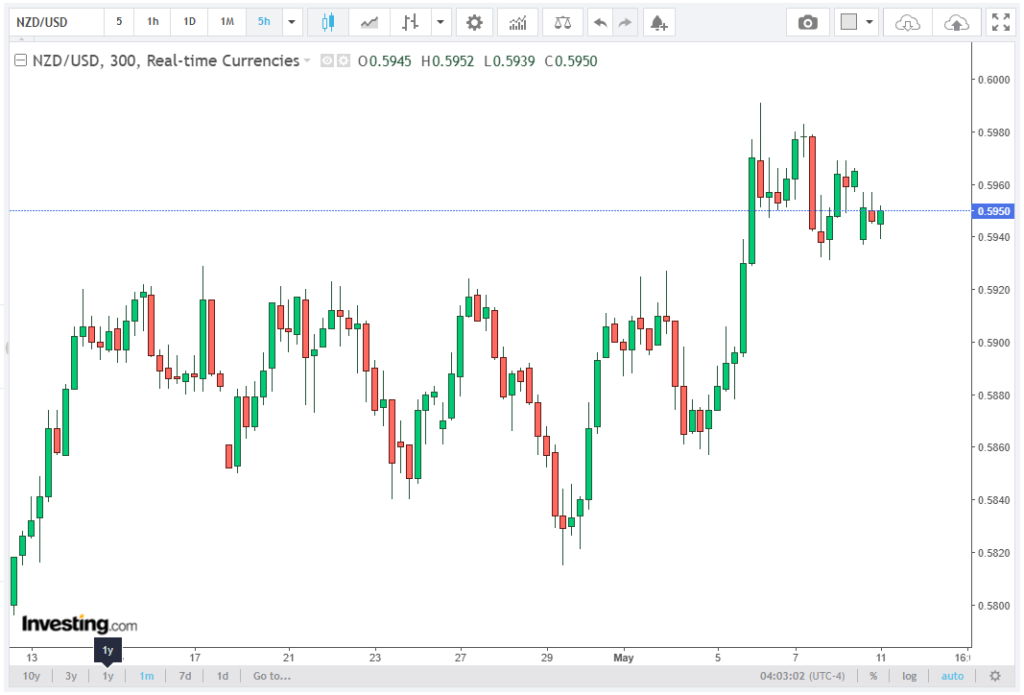
The New Zealand Dollar (NZD) is showing a cautious performance against the US Dollar (USD) on Monday, trading below last week’s highs but remaining steady above the 0.5930 support level.
Market participants are weighing strong Chinese economic data against rising geopolitical tensions in the Middle East and higher Oil prices, creating a mixed environment for the Kiwi. In this article, Rubizio’s brokers offer a thorough analysis of the subject.
NZD/USD Holds Within Narrow Ranges
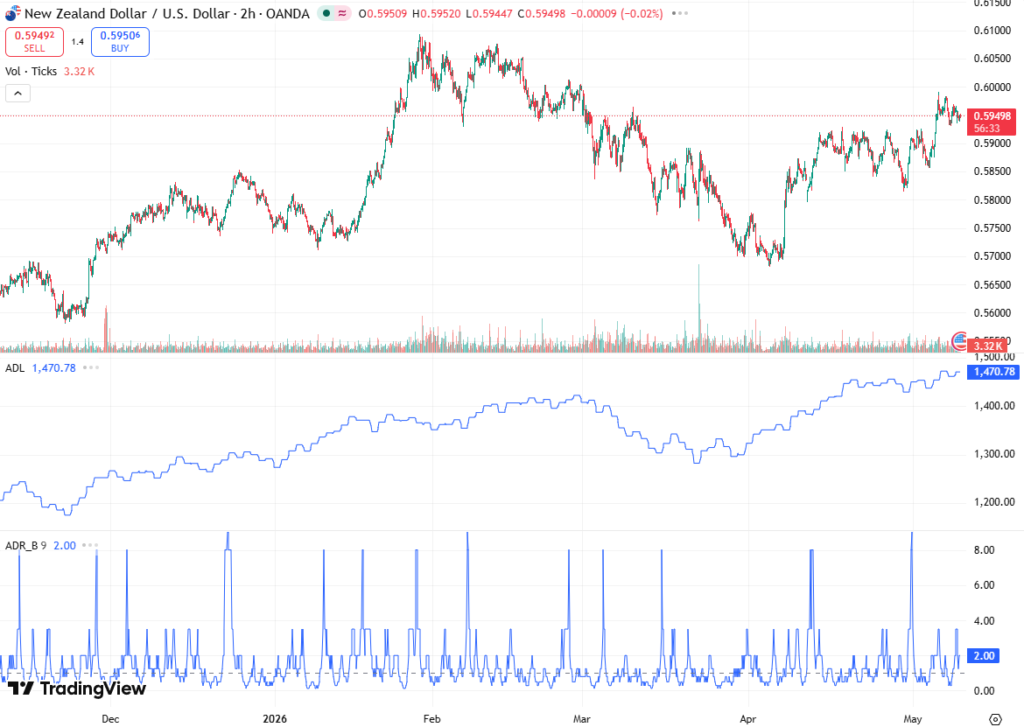
The NZD/USD pair is currently consolidating, struggling to maintain the momentum seen at the end of last week. On Monday, the pair retreated from Friday’s highs, hovering in the 0.5940–0.5950 range, while keeping above the late April lows near 0.5930. This range-bound behavior reflects the balance between supportive fundamentals from New Zealand’s trade partner, China, and external headwinds such as rising Oil costs and geopolitical uncertainty.
Despite the minor pullback, the NZD remains relatively resilient, indicating that investor confidence is still cautiously positive. Analysts note that the key support at 0.5930 will be critical for sustaining the current range. A breach below this level could trigger further downside pressure, while a sustained move above 0.5950–0.5960 could open the path toward last week’s highs around 0.5980.
Chinese Data Boosts NZD
Chinese economic indicators released over the weekend and Monday have provided notable support for the Kiwi. Consumer Price Index (CPI) data for April surprised the market, rising 1.2% year-on-year (YoY) versus expectations of 0.8%, up from March’s 1.0% reading. Meanwhile, Producer Price Index (PPI) inflation accelerated to 2.8% YoY, a three-year high, surpassing the 1.5% consensus.
These figures suggest that price pressures are building in China, alleviating some concerns about deflationary risks in the region. For New Zealand, strong Chinese inflation is a positive factor, as China is a major export partner, and higher economic activity abroad tends to support NZD demand.
Additionally, Chinese trade balance data released over the weekend showed a sharp increase in exports, driven by higher demand for industrial and agricultural products. The positive trade numbers are expected to benefit New Zealand’s export-oriented economy, reinforcing the NZD’s underlying strength.
Geopolitical Concerns Weigh on the Kiwi
While Chinese fundamentals are supportive, geopolitical developments are exerting pressure on the NZD. US-Iran tensions remain unresolved, following comments from the US President labeling Iran’s latest peace proposal as “unacceptable.” These developments have fueled concerns about a prolonged conflict in the Middle East, particularly regarding the Strait of Hormuz, a critical global shipping route for Oil.
The immediate market reaction saw Brent Oil prices climbing above $100 per barrel, increasing the cost of imports for Oil-dependent economies like New Zealand. Higher energy prices often weigh on risk sentiment, curbing NZD bulls and encouraging investors to favor the USD as a safe-haven asset.
Oil Prices and Risk Appetite
Oil prices have emerged as another major influence on NZD trading dynamics. Brent crude surpassing $100 has direct implications for New Zealand’s trade balance and inflation outlook, given that the country is a net Oil importer. Elevated Oil costs tend to weigh on consumer spending and broader economic growth, creating a headwind for risk-sensitive currencies like the Kiwi.
For traders, higher Oil prices act as a cautionary signal. While NZD bulls can rely on strong Chinese demand for New Zealand exports, the offsetting impact of rising energy costs and geopolitical risks suggests that upside momentum could remain capped in the near term.
Market Outlook
Looking ahead, the NZD/USD pair is likely to continue trading in a range-bound pattern, with key levels at 0.5930 support and 0.5950–0.5960 resistance. Chinese economic data will remain a crucial driver, with investors focusing on further CPI, PPI, and trade figures for clues on NZD strength.
At the same time, geopolitical headlines, particularly regarding US-Iran relations and Oil market developments, will continue to exert influence. Any positive signs of de-escalation could allow NZD bulls to test 0.5980, while renewed tensions or further Oil price spikes could push the pair back toward 0.5930.
Investors are also watching for scheduled meetings between the US President and Chinese President Xi Jinping, which could address Iran, nuclear issues, and trade matters.
Conclusion
In summary, the New Zealand Dollar is navigating a complex environment. Strong Chinese inflation and trade data support the Kiwi, but rising Oil prices and persistent geopolitical uncertainty are constraining upside potential. The NZD/USD pair remains range-bound between 0.5930 and 0.5950, with traders closely monitoring economic releases and geopolitical developments.
For now, the market sentiment is balanced, with neither bulls nor bears gaining a decisive edge. Investors are advised to remain vigilant, as shifts in Oil prices or sudden geopolitical escalations could quickly alter the NZD/USD trajectory in the coming sessions.


