
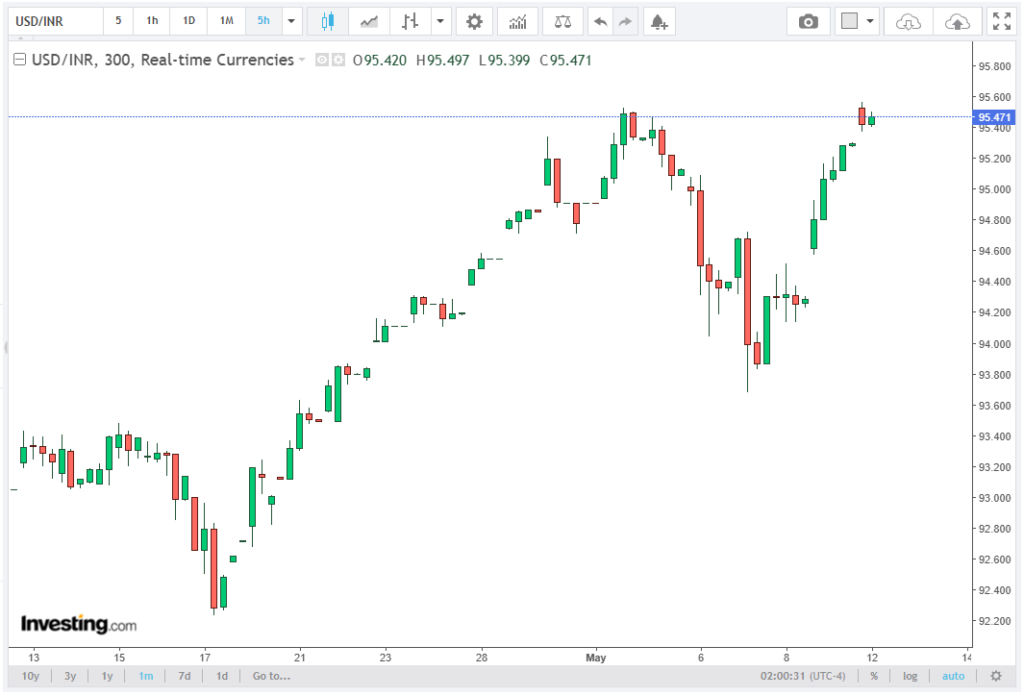
The Indian Rupee (INR) has tumbled to a fresh all-time low against the US Dollar (USD), with the USD/INR pair surging to 95.60 in early Tuesday trade. The sharp decline follows renewed geopolitical tensions between the United States (US) and Iran, triggering fears over a prolonged closure of the Strait of Hormuz, a critical maritime passage accounting for nearly 20% of global energy supply.
This development has sent shockwaves across emerging market currencies, particularly those from oil-importing economies like India, which rely heavily on crude imports to meet domestic energy demands.
As of writing, WTI crude oil trades slightly below $96 per barrel, reflecting a cautious market stance amid escalating uncertainty in the Middle East. The specialists at Marbrisse deliver a comprehensive guide to this topic in this publication.
US-Iran Tensions and the Strait of Hormuz Risk
The renewed US-Iran confrontation has raised fears of disruptions in global oil supply, which could further pressure inflation-sensitive currencies such as the INR. The Strait of Hormuz remains a strategic chokepoint, and any prolonged closure could elevate crude prices, intensifying India’s import bill.
The US President criticized Iran’s counterproposal to a peace initiative, labeling it as stupid and emphasizing Tehran’s indecision regarding its nuclear ambitions. He further indicated that the ceasefire is in serious jeopardy, suggesting a potential escalation in military operations.
Reports from CNN indicate growing frustration with Iran’s negotiation stance, with aides noting that major combat operations could be resumed, raising geopolitical risks for global markets.
Impact on Oil Prices and Emerging Market Currencies
Any prolonged disruption in the Hormuz corridor typically drives oil prices higher, which negatively impacts oil-importing countries. India, which imports over 80% of its crude requirements, faces rising fiscal pressures and current account deficits when WTI and Brent crude surge.
As a result, the Indian Rupee faces additional selling pressure, with USD/INR climbing to new highs. Higher oil prices increase the import bill, potentially exacerbating inflationary pressures and influencing the Reserve Bank of India (RBI) to adopt a more cautious monetary policy stance.
Foreign Institutional Investor (FII) Activity
Amid escalating geopolitical and economic uncertainty, Foreign Institutional Investors (FIIs) have maintained a selling spree in the Indian equity market. In May, FIIs have remained net sellers in five of six trading sessions, offloading shares worth approximately Rs. 19,509.91 crore.
The continued FII outflow reflects concerns about corporate earnings, particularly for sectors sensitive to energy price shocks, and highlights investor preference for safe-haven assets amid global tension.
Investors Eye India-US CPI Data for April
Investors are closely watching the upcoming India and US Consumer Price Index (CPI) data for April, as these figures could significantly influence expectations for both the Reserve Bank of India (RBI) and the Federal Reserve (Fed). Market participants are particularly focused on inflation trends, which play a key role in shaping central bank policy decisions.
India’s CPI is expected to rise to 3.8% YoY in April from 3.4% in March, indicating slightly higher domestic inflation that may influence RBI policy, while US inflation is projected at 3.7%, up from 3.3%, reflecting ongoing price pressures and possible Fed policy implications.
Overall, the CPI data from both countries are highly anticipated because they could impact monetary policy decisions and influence the USD/INR exchange rate, affecting cross-border trade, investment flows, and broader financial market sentiment.
Safe-Haven Demand Strengthens the US Dollar
The US Dollar Index (DXY) has gained approximately 0.25%, trading near 98.15, as investors seek safe-haven exposure amid Middle East tensions. The strengthened USD has amplified pressure on the INR, pushing the USD/INR pair to record levels.
This week, market attention is also focused on the US-China bilateral meeting, scheduled during the US President’s visit from May 13-15. Discussions are expected to cover Middle East conflict resolution, Taiwan, Artificial Intelligence (AI), and rare-earth elements, adding further market volatility in the near term.
Technical Analysis: USD/INR Extends Bullish Momentum
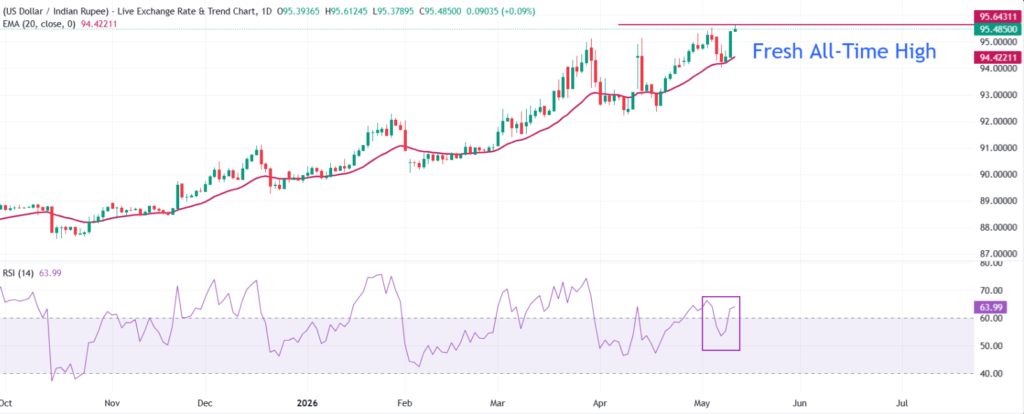
From a technical standpoint, the USD/INR pair trades near 95.60, maintaining a bullish bias above the 20-day exponential moving average (EMA) at 94.4221. The pair has been forming a sequence of higher closes, suggesting continued upside momentum.
The Relative Strength Index (RSI), near 64 points, indicates firm but not overbought conditions, implying that buying interest could persist during dips. On the upside, the next psychological resistance is at 96.00, whereas support lies at the 20-day EMA, with a potential corrective level around 94.00 if the pair breaches the EMA.
Conclusion
In conclusion, the Indian Rupee faces persistent downward pressure due to a combination of geopolitical risks, rising oil prices, and USD strength. Market participants should closely monitor CPI data, FII flows, and technical support levels to navigate the current volatility in USD/INR effectively.


