
European equity markets moved higher as investors responded to strong corporate earnings signals, particularly from industrial technology leaders benefiting from accelerating artificial intelligence investment. Analysts monitoring the industrial technology sector note that AI-driven infrastructure expansion is becoming a major catalyst for earnings growth, according to portfolio research analysts at Yureplex.
The pan-European Stoxx 600 index rose approximately 0.4% in early trading, reflecting broad investor optimism across multiple sectors. Gains were led by industrial and luxury stocks, while some consumer and technology names faced pressure following mixed earnings updates.
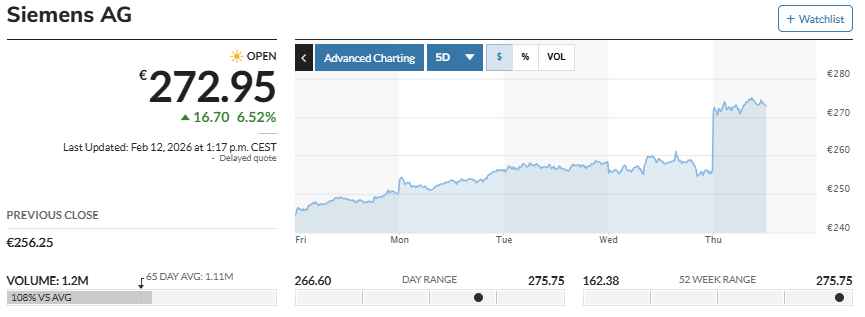
Siemens Raises Earnings Guidance Amid AI Momentum
Shares of Siemens jumped sharply after the engineering giant upgraded its profit outlook, citing strong demand tied to artificial intelligence applications across industrial operations and data center infrastructure.
The company lifted its fiscal 2026 basic earnings per share forecast to a range between €10.7 and €11, compared with its previous guidance of €10.4 to €11. The improved outlook reflects sustained momentum in industrial automation, smart manufacturing solutions, and digital infrastructure technologies.
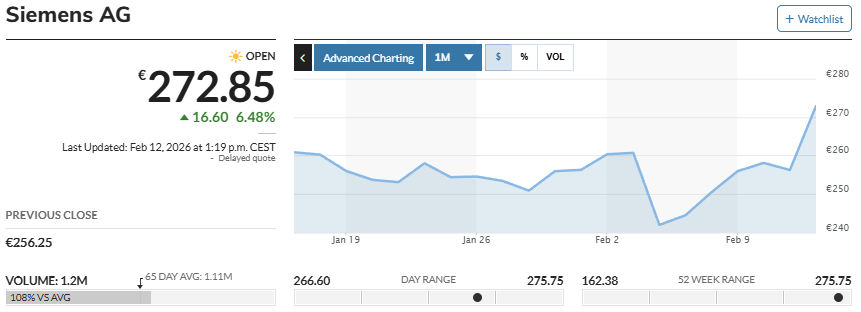
Investors responded positively to the upgraded projections, sending Siemens shares up nearly 7% during early market trading. The rally highlights growing investor confidence in companies positioned at the center of AI-driven industrial transformation.
Management emphasized that AI adoption within manufacturing processes, product engineering, and operational efficiency systems is accelerating faster than initially anticipated. Analysts note that industrial AI applications are expected to become a major driver of long-term productivity gains across global supply chains.
Broader European Markets Show Mixed Earnings Impact
While Siemens led gains, broader European markets reflected mixed corporate results across sectors.
Luxury goods manufacturers recorded notable advances following stronger-than-expected earnings reports. A leading French luxury brand posted a 9.8% increase in fourth-quarter revenue, supported by robust consumer demand in North America and Asia.
Operating profit for the luxury group reached approximately €6.6 billion, exceeding analyst expectations and lifting investor sentiment toward the broader luxury sector. Shares of several global luxury firms rose between 1% and 3%, reflecting renewed confidence in high-end consumer demand resilience.
Technology And Consumer Stocks Face Pressure
Not all sectors benefited from the positive market momentum. A major European fintech company experienced a sharp decline after reporting revenue growth that failed to meet investor expectations.
Despite posting a 17% increase in net revenue, the company’s shares fell more than 17%, highlighting heightened market sensitivity toward profitability outlooks and sustainable growth expectations within the financial technology sector.
Similarly, a newly listed consumer goods spin-off saw its stock drop approximately 14% after reporting a steep 48% decline in full-year profits, raising concerns about cost pressures, demand normalization, and margin sustainability.
Industrial And Financial Developments Support Market Stability
Elsewhere in the European markets, several corporate developments helped support broader investor confidence.
A major German exchange operator announced plans to acquire a 20% stake in a global index provider for approximately $1.3 billion, strengthening its position in financial data, analytics services, and market infrastructure capabilities.
Additionally, an asset management acquisition valued at approximately £9.9 billion boosted shares of a prominent U.K. investment firm, contributing to positive sentiment within financial services equities.
Global Factors Continue Influencing Market Direction
European market performance was also influenced by developments across global equity markets and macroeconomic conditions.
Asian markets recorded strong gains, with Japan’s Nikkei 225 index surpassing 58,000 points for the first time in history, driven by continued investor optimism following recent political and economic policy developments.
Meanwhile, U.S. equity futures remained relatively stable as investors awaited key economic data releases, corporate earnings signals, and interest rate outlook updates.
AI Investment Emerges As A Structural Growth Driver
Market analysts emphasize that artificial intelligence investment is increasingly reshaping earnings outlooks across multiple sectors, particularly within industrial technology, manufacturing automation, and data infrastructure development.
Companies positioned to support AI deployment through hardware, software, and operational solutions are expected to benefit from sustained multi-year demand growth. Industrial AI applications are projected to enhance productivity, reduce operational costs, and improve supply chain efficiency across global industries.
As a result, investor attention continues shifting toward firms capable of delivering scalable AI-enabled solutions rather than relying on traditional cyclical growth drivers.
Outlook For European Equity Markets
Looking ahead, market performance is expected to remain closely tied to corporate earnings momentum, macroeconomic indicators, and global technology investment cycles.
Analysts anticipate that AI-related capital spending will remain a central factor supporting equity valuations, particularly within industrial and technology sectors. However, ongoing cost pressures, geopolitical uncertainties, and sector-specific challenges may continue to create uneven performance across European markets.
Overall, recent trading patterns suggest that investors are increasingly prioritizing companies with strong exposure to structural growth trends, especially those linked to artificial intelligence, automation, and digital infrastructure development.


