
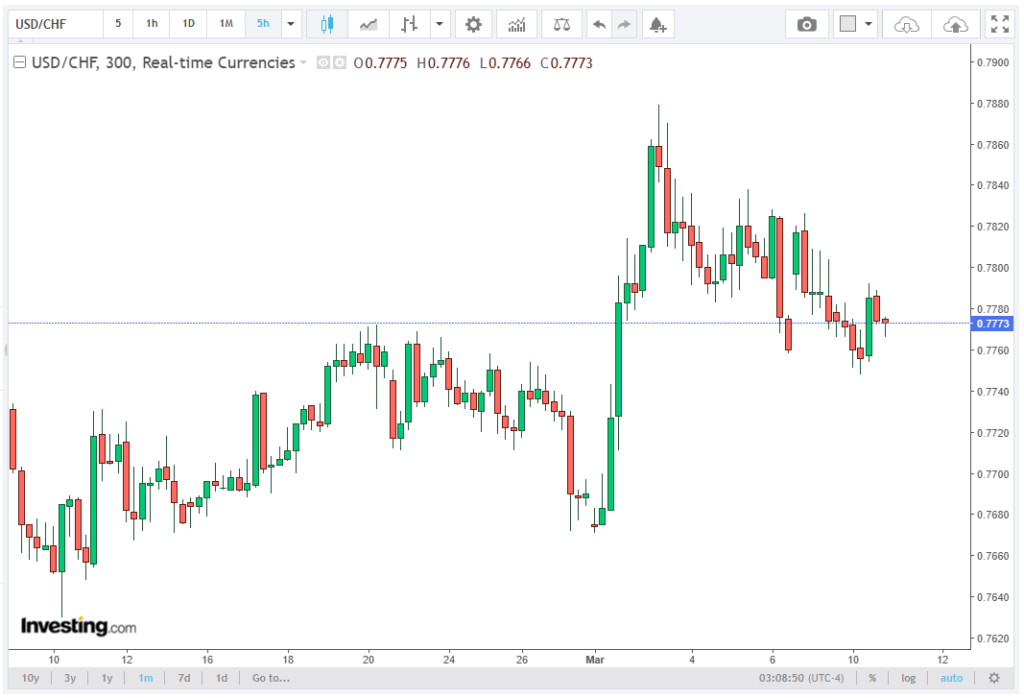
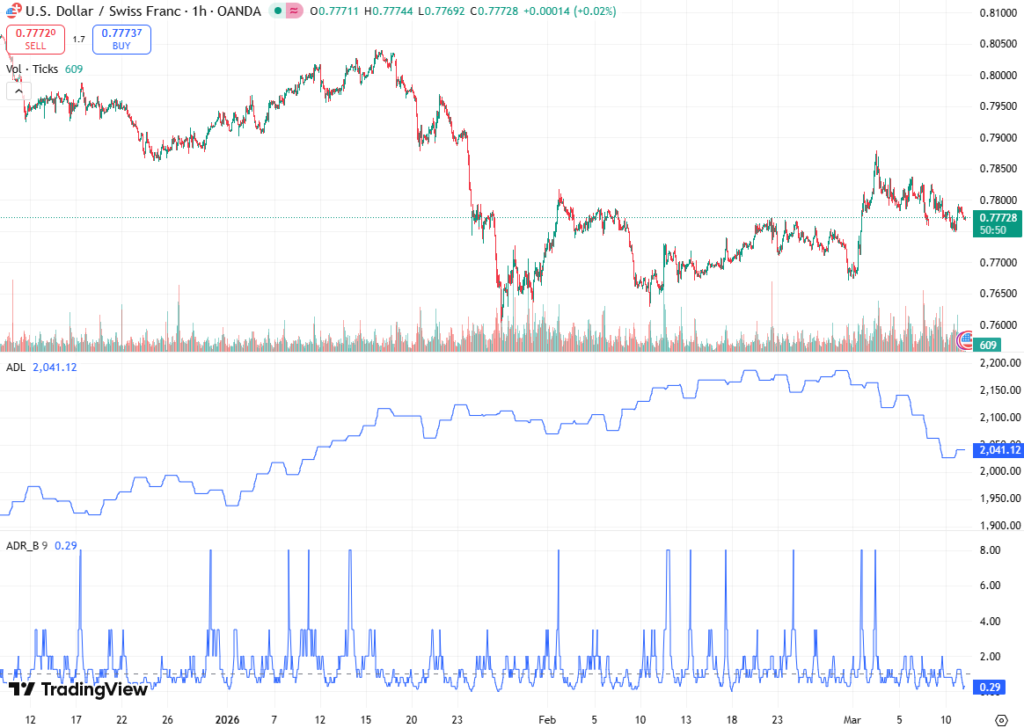
The USD/CHF currency pair edged lower during Wednesday’s early European session, sliding toward the 0.7765 level as traders positioned themselves ahead of key US inflation data. The brokers at Byronixel take a closer look at this topic in the article below.
The move reflects a combination of renewed safe-haven demand for the Swiss Franc (CHF) and cautious sentiment in global financial markets. Investors are increasingly focusing on geopolitical risks and upcoming macroeconomic indicators, both of which are influencing near-term price action in the foreign exchange (FX) market.
At the time of writing, USD/CHF is trading close to 0.7765, marking a modest decline for the US Dollar (USD) against its Swiss counterpart. The Swiss Franc, traditionally viewed as a safe-haven currency, has found support amid escalating geopolitical tensions in the Middle East, which have triggered defensive positioning among investors.
Market participants remain cautious ahead of the US February Consumer Price Index (CPI) report, a critical release that could significantly influence expectations surrounding future Federal Reserve (Fed) monetary policy.
War Premium and Its Impact on Safe-Haven Currencies
The ongoing conflict has also introduced a “war premium” into financial markets. This concept refers to the additional value placed on safe-haven assets during periods of geopolitical risk. The Swiss Franc, along with other defensive currencies such as the Japanese Yen, typically benefits from such conditions.
However, analysts caution that the strength of the CHF may be limited if geopolitical tensions begin to ease. Any positive diplomatic developments or progress toward a resolution of the Iran conflict could quickly diminish the war premium currently embedded in markets.
Should tensions de-escalate, investor confidence may improve, prompting a rotation back into risk-sensitive assets and reducing demand for safe-haven currencies. In such a scenario, USD/CHF could stabilize or recover, particularly if US economic data remains strong.
Market Focus Shifts to US CPI Inflation Data
Beyond geopolitical developments, traders are closely watching the upcoming US Consumer Price Index (CPI) inflation report, scheduled for release later on Wednesday. The CPI report is widely considered one of the most influential economic indicators for assessing inflation trends in the United States.
The data is particularly important because it plays a key role in shaping expectations regarding Federal Reserve interest rate policy. Financial markets closely analyze CPI figures to determine whether the Fed may tighten or loosen monetary policy in the coming months.
Economists currently forecast that headline CPI inflation will rise by 2.4% year-over-year in February. Meanwhile, core CPI, which excludes volatile food and energy prices, is expected to increase by 2.5% annually.
If the data aligns with these projections, markets may interpret the report as moderately stable inflation, potentially reinforcing expectations for gradual monetary policy adjustments by the Federal Reserve.
Federal Reserve Policy Expectations in Focus
The Federal Reserve’s interest rate outlook remains one of the most significant drivers of US Dollar performance. Over the past year, inflation trends have played a central role in determining whether the Fed maintains a restrictive monetary stance or begins shifting toward policy easing.
Should the February CPI report exceed market expectations, it could signal that inflationary pressures remain persistent in the US economy. A hotter-than-expected inflation reading may lead investors to anticipate fewer interest rate cuts or a longer period of elevated rates.
In such a scenario, US Treasury yields could move higher, strengthening the US Dollar and potentially pushing the USD/CHF pair upward.
Conversely, if inflation data comes in below forecasts, it could reinforce expectations that the Federal Reserve may adopt a more accommodative policy stance later this year. Lower inflation could increase speculation about rate cuts, which would likely weigh on the US Dollar and allow the Swiss Franc to extend its gains.
Technical Outlook for USD/CHF
From a technical analysis perspective, the 0.7750–0.7765 zone represents an important short-term support area for USD/CHF. A decisive break below this level could open the door for further downside movement toward 0.7700, a psychologically significant level closely watched by traders.
On the upside, resistance may emerge around the 0.7800 level, followed by 0.7850, where previous price consolidation occurred. Market momentum indicators currently suggest cautious bearish sentiment, though upcoming economic data could quickly shift the outlook.
Conclusion
In summary, the USD/CHF pair has softened toward 0.7765 during Wednesday’s early European trading hours, primarily driven by strong demand for the Swiss Franc as a safe-haven asset amid escalating Middle East tensions. The evolving geopolitical situation continues to shape global risk sentiment, supporting defensive currencies.
However, the near-term trajectory of the pair will likely depend on the outcome of the US February CPI inflation report. Stronger-than-expected inflation could boost the US Dollar by reinforcing expectations of tight Federal Reserve policy, while weaker data may extend CHF gains.


