
Palantir Technologies (PLTR) has become one of the most polarizing stocks in the market, drawing comparisons to Tesla for reasons that go well beyond headline-grabbing growth rates. Like Tesla in its earlier years, Palantir is a company many investors consider wildly overvalued, yet its share price continues to hold up, powered by strong narrative momentum, enthusiastic retail investors, and a compelling long-term vision centered on artificial intelligence.
From Arbitics’s financial analyst perspective, the key question is not whether Palantir looks expensive on traditional metrics, it clearly does, but whether its stock behaves more like a fundamentals-driven investment or a sentiment-driven phenomenon similar to Tesla’s long run.
Palantir’s AI Platform Is Driving Real Growth
At the core of Palantir’s appeal is its Artificial Intelligence Platform (AIP), which allows organizations to embed AI agents directly into real-world workflows. These agents can operate autonomously or alongside human decision-makers, automating complex tasks that traditionally required significant manual effort.
Originally built for government intelligence and defense applications, Palantir has successfully expanded into the commercial sector, and that shift is showing up clearly in the numbers. In its most recent quarter, commercial revenue surged 73% year over year to $548 million, while government revenue climbed 55% to $633 million. Combined, this delivered total quarterly revenue of $1.18 billion, representing 63% overall growth.
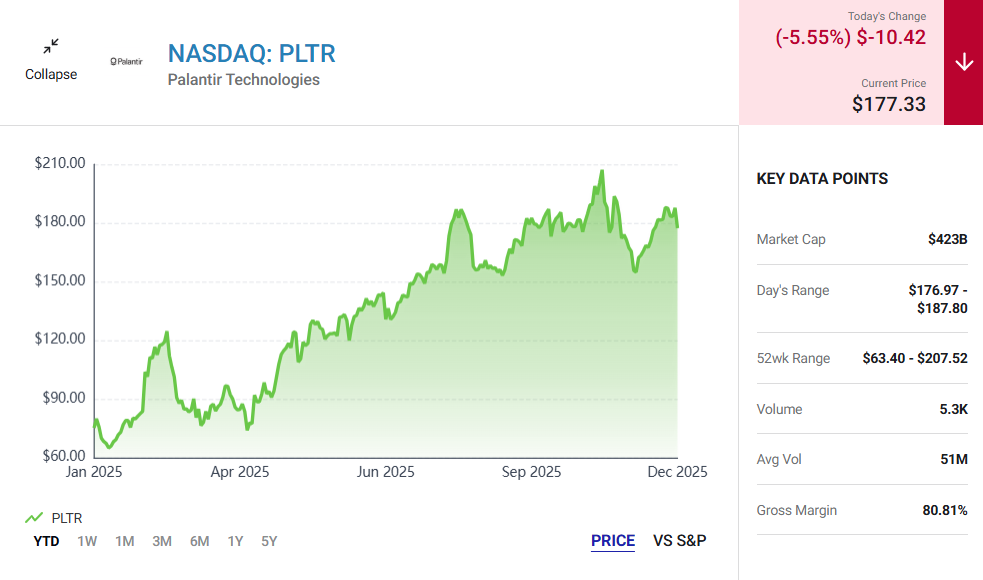
Importantly, Palantir is not sacrificing profitability to achieve this expansion. The company posted a profit margin of roughly 40%, an unusually strong figure for a high-growth AI software firm. This combination of rapid growth and solid margins has helped Palantir build credibility beyond being just a speculative AI play.
A Valuation That Defies Traditional Logic
Despite its operational success, Palantir’s valuation is where the controversy begins. The stock currently trades at approximately 123 times sales and 259 times forward earnings, placing it among the most expensive large-cap stocks in the market.
To put that into context, consider Nvidia, a company widely regarded as the backbone of the AI infrastructure boom. NVIDIA recently reported 62% revenue growth, profit margins above 56%, and is expected to grow revenue by 48% next year, compared to Palantir’s estimated 41%. Yet Nvidia trades at roughly 24 times sales and 39 times forward earnings, a fraction of Palantir’s valuation.
By conventional standards, for Palantir to “grow into” its current valuation without a stock price increase, its underlying financials would need to expand severalfold, an outcome that many analysts view as unrealistic in the near to medium term.
The Tesla Parallel: Retail Ownership Matters
This is where the Tesla comparison becomes relevant. Tesla has spent years being labeled overvalued, with skeptics repeatedly expecting a major correction. Instead, its stock has repeatedly rebounded, largely because it is heavily influenced by retail investors who buy into the company’s vision rather than its discounted cash flow models.
Institutional ownership data support this comparison. About 48% of Tesla shares are held by institutions, far lower than peers like Meta Platforms or Berkshire Hathaway. Palantir shows a similar pattern, with institutional ownership around 56.5%, compared with 65% for AMD and nearly 90% for Mastercard.
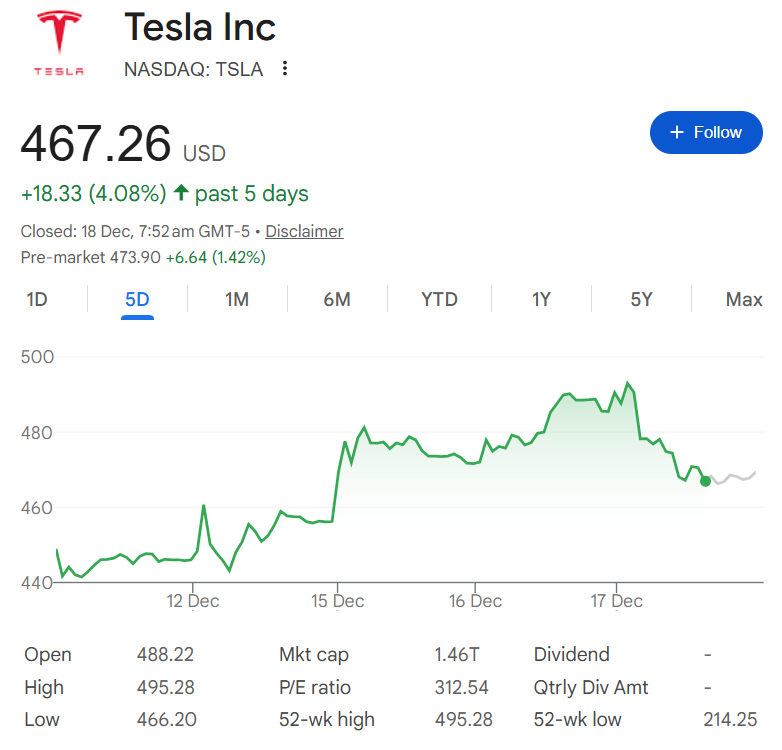
Lower institutional ownership often means price behavior is driven more by individual investors, who are less sensitive to valuation multiples and more responsive to growth stories, leadership narratives, and long-term disruption themes. In such cases, traditional valuation frameworks lose some of their predictive power.
What This Means for Investors
For investors who rely heavily on fundamentals and valuation discipline, Palantir may feel uncomfortable, or even untouchable, at current levels. From that standpoint, avoiding the stock entirely can be a rational decision.
However, history suggests that betting against sentiment-driven stocks can be costly, especially when retail enthusiasm aligns with a powerful long-term theme like AI. Just as Tesla defied skeptics for years, Palantir could continue to trade at elevated multiples as long as growth remains strong and its AI narrative resonates.
Palantir increasingly resembles a stock that may not behave rationally in the traditional sense, much like Tesla during its most controversial phases. Investors should be clear about which side of that divide they fall on. If valuation discipline is paramount, staying on the sidelines may make sense.
If understanding market psychology and long-term narrative momentum is part of the strategy, Palantir’s trajectory may be less surprising, even at seemingly extreme valuations. In short, Palantir may not be “the next Tesla” in business model or industry, but in how its stock is priced and traded, the parallels are becoming harder to ignore.


