
West Texas Intermediate (WTI) crude oil prices surged to near $96.60 at the start of the week, driven by renewed geopolitical uncertainty over the US-Iran permanent resolution. The oil market reacted strongly after the US President dismissed Iran’s recent response to the peace proposal, heightening expectations of continued supply-side tensions. This article features an in-depth explanation of the subject from the brokers at Winseterra.
Oil Prices Climb Amid US-Iran Tensions
WTI futures on NYMEX jumped 5.2% during the Asian session, reflecting growing concerns over a prolonged standoff between the United States and Iran. Traders are reacting to diminishing hopes that a permanent ceasefire between the two nations will be achieved in the near term.
Over the weekend, the US President criticized Iran’s response to the one-page peace proposal, calling it “totally unacceptable” in a post on Truth Social. This strong rejection has tempered market expectations for an imminent diplomatic resolution, reinforcing geopolitical risk as a major factor in the current WTI price dynamics.
Meanwhile, Iranian state media reported that Tehran is demanding recognition of its authority near the Strait of Hormuz, compensation for war damages, the release of frozen assets, and the lifting of sanctions, according to CNN. The Strait of Hormuz is a critical chokepoint, channeling nearly 20% of global energy supply, and fears of a closure continue to underpin bullish sentiment in the oil market.
Broader Market Factors
While geopolitical risks are currently dominating, broader macroeconomic factors also influence oil prices. Growing concerns that the Federal Reserve (Fed) may maintain interest rates at elevated levels for an extended period could temper upside momentum.
Elevated energy prices have contributed to de-anchored inflation projections, while robust Nonfarm Payrolls (NFP) data for April signal a resilient labor market.
Although these factors could influence the trajectory of WTI, they are likely to have a limited immediate effect, given the dominant role of geopolitical uncertainty. Traders remain attentive to any developments regarding the US-Iran conflict, which continues to provide the primary impetus for short-term oil price movements.
WTI Technical Analysis: Bullish Bias Emerges
WTI US Oil is trading strongly at around $96.60 in the Asian session. The contract has returned above its 20-day exponential moving average (EMA) at $95.39, signaling that the recent pullback is more consolidative than a full reversal. This technical behavior suggests the near-term bias is bullish, and buyers are likely to retain control of the market.
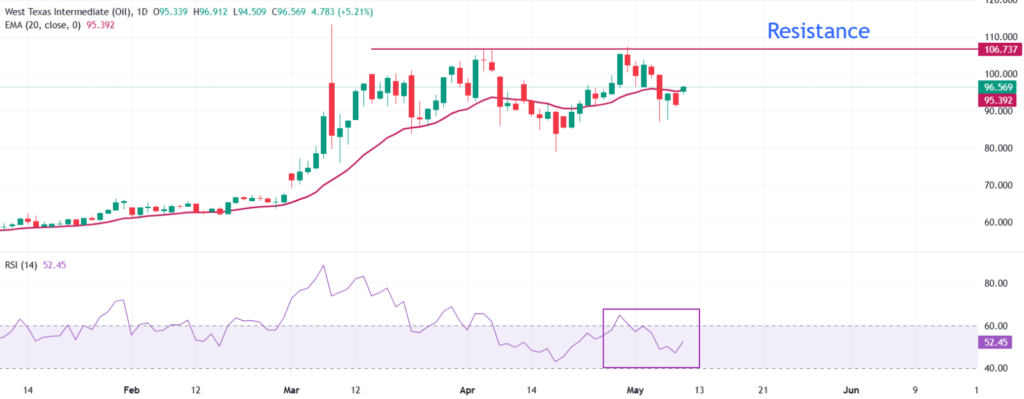
The Relative Strength Index (RSI) currently stands at 52.45, which is in neutral territory. This indicates modest positive momentum without signs of overbought or oversold conditions, providing room for further upward movement. Traders often view RSI in this range as confirmation that a trend continuation is possible, especially when prices are above a key moving average.
Key Support and Resistance Levels
On the downside, immediate support is identified at the 20-day EMA near $95.39. A break below this level could expose a deeper correction toward $90, where buyers may once again attempt to regain control.
On the upside, if WTI maintains momentum above the 20-day EMA, the next target is the psychological level of $100, followed by the April 30 high of $107.35. These levels represent potential resistance where profit-taking or renewed market uncertainty could temporarily stall gains.
Market Outlook
The combination of geopolitical tension, technical strength, and supportive market sentiment points to a cautiously bullish outlook for WTI crude oil. While macroeconomic factors, including interest rate policies and inflation trends, may provide counterpressure, the overriding influence remains US-Iran relations and the potential disruption of energy flows through the Strait of Hormuz.
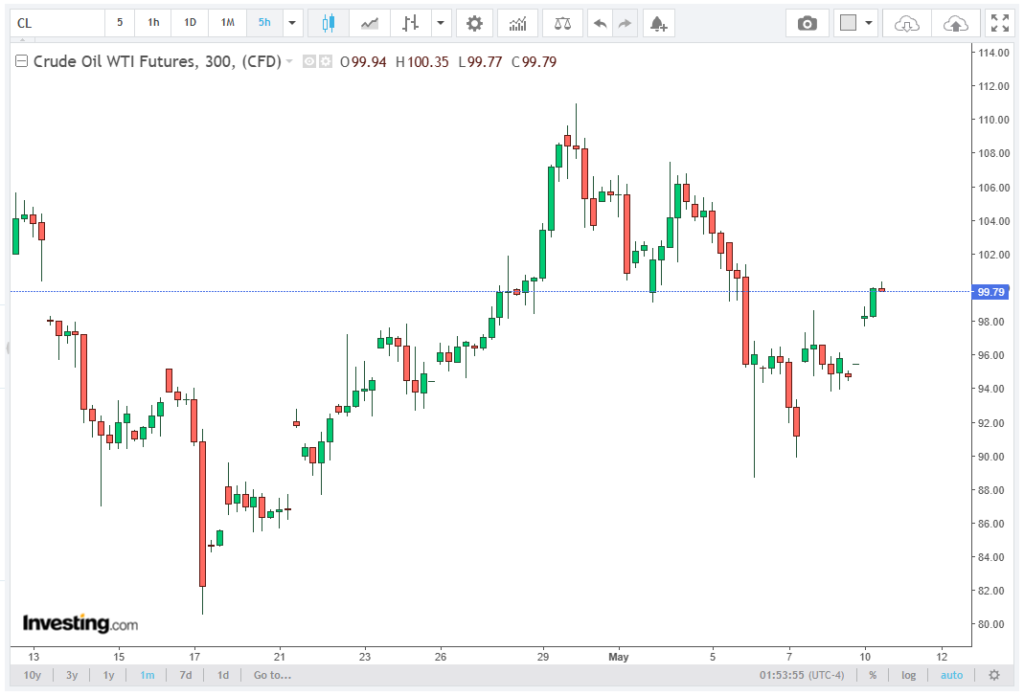
Market participants should monitor key technical levels, particularly the 20-day EMA, as well as any updates from Iranian or US officials. Sudden geopolitical developments could trigger sharp price swings, and traders are likely to react swiftly to any signs of escalation or diplomatic progress.
Conclusion
WTI futures have returned above the 20-day EMA, signaling a bullish near-term bias, while RSI readings suggest modest momentum without excessive overextension. The recent US dismissal of Iran’s response has reinforced geopolitical risks, keeping the oil market on alert. Key support remains near $95.39, with potential upside targets at $100 and $107.35.
Investors are also closely watching oil inventory reports and OPEC+ production signals, as any unexpected supply adjustments could amplify price volatility. With WTI trading above key technical levels, even minor disruptions in production or shipping through the Strait of Hormuz could trigger sharp short-term moves, reinforcing the market’s sensitivity to both geopolitical events and supply-demand fundamentals.
As long as WTI maintains above the 20-day EMA, buyers are likely to remain in control, while ongoing US-Iran tensions continue to dominate the price outlook. Traders should remain vigilant, balancing technical signals with geopolitical developments to navigate this volatile market.


