
West Texas Intermediate (WTI) oil futures on NYMEX corrected to near $97.20 during the European trading session on Wednesday, as the oil price surrendered some of its early gains. The retreat comes amid growing concerns over the oil demand outlook, fueled by hawkish Federal Reserve (Fed) bets and rising US inflation figures.
Despite this short-term pullback, the broader WTI outlook remains firm due to persistent geopolitical risks, particularly surrounding the Strait of Hormuz. This article presents an in-depth analysis of the issue, courtesy of Byronixel specialists.
Oil Price Retreat Amid Hawkish Fed Expectations
The WTI price experienced a modest decline after early gains, reflecting market sensitivity to the US macroeconomic environment. Hotter-than-expected US CPI data for April has raised the probability of a hawkish Fed stance. On Tuesday, the US headline Consumer Price Index (CPI) recorded a Year-on-Year (YoY) increase of 3.8%, surpassing estimates of 3.7% and the March reading of 3.3%.
Higher inflation strengthens expectations that the Federal Reserve may adopt a tighter monetary policy, including interest rate hikes. Such a scenario typically acts as a headwind for oil demand, as higher borrowing costs can slow economic activity and industrial consumption, thereby exerting downward pressure on energy prices.
As a result, the WTI market saw a corrective move from its recent highs, reflecting investor caution over the interplay between monetary policy and global oil demand dynamics.
Geopolitical Risks Keep Oil Prices Supported
Despite the near-term pullback, the fundamental backdrop for WTI crude remains firm. A prolonged closure of the Strait of Hormuz, a critical maritime passage through which nearly 20% of global energy supply transits, could continue to keep oil prices elevated.
Negotiations between the United States and Iran have yet to yield a breakthrough, leaving the geopolitical risk premium intact. Historical patterns suggest that disruptions in the Strait of Hormuz often prompt rapid spikes in crude prices, as markets anticipate constrained supply flows.
This geopolitical uncertainty is a key factor underpinning the bullish medium-term WTI outlook, even as short-term technicals show a corrective phase. Investors are closely monitoring developments in the region, understanding that supply-side shocks could override temporary demand concerns stemming from a hawkish Fed.
Focus on US-China Trade Talks
Market participants are also paying attention to the scheduled US-China summit, with meetings between the US President and the Chinese leader set for Thursday and Friday. Any progress in trade negotiations could positively influence oil demand sentiment, particularly if a resolution eases concerns over global economic growth.
Conversely, delays or setbacks could amplify downside risks, reinforcing the caution seen in the WTI price over the last session. The market’s sensitivity to both geopolitical tensions and trade developments highlights the dual factors shaping near-term crude volatility.
WTI Technical Analysis
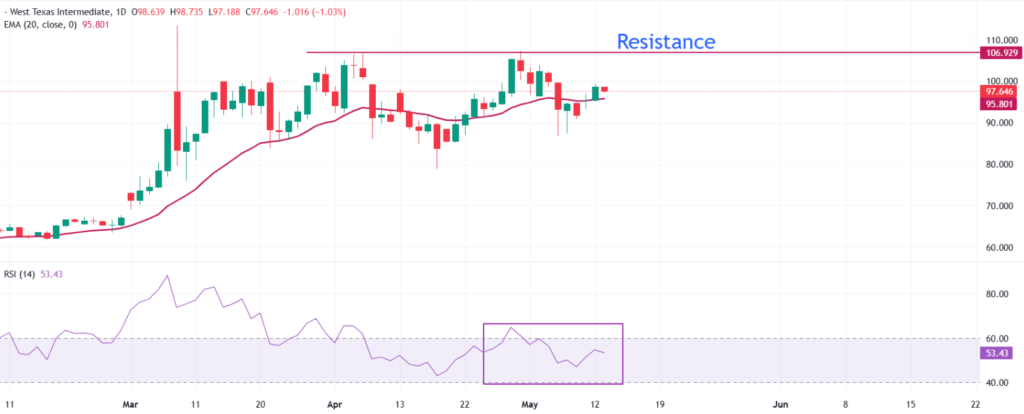
From a technical perspective, WTI US Oil declined to around $97.20, yet the near-term bias remains constructive. Prices have maintained levels above the 20-day exponential moving average (EMA) at approximately $95.80, signaling that the recent pullback is likely a correction within a broader uptrend rather than a sustained downtrend.
The Relative Strength Index (RSI), currently hovering around 53, reinforces a neutral-to-positive tone, suggesting that upside momentum is still intact without being overextended.
Support levels are now closely watched. Immediate support aligns with the 20-day EMA at $95.80, where a break could expose a deeper retracement toward $90. On the upside, the broader recovery bias remains in place as long as buyers defend the 20-day EMA on closing bases, leaving room for renewed upward attempts toward the $100 handle, and potentially revisiting the April 30 high of $107.35.
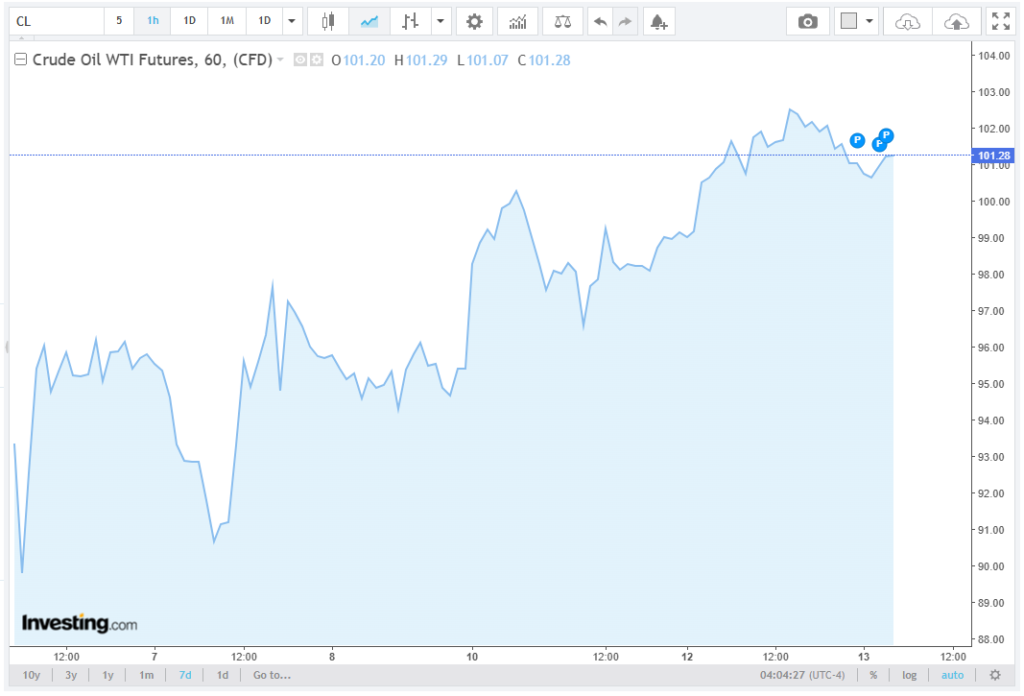
Technical traders are likely to monitor moving averages, RSI readings, and price action for signals of either continued uptrend momentum or a more sustained correction.
Key Takeaways
WTI oil corrected to around $97.20, giving back some early session gains amid rising Fed hawkishness. US CPI data for April came in at 3.8% YoY, exceeding expectations and fueling rate hike bets as well as concerns about oil demand. Despite the pullback, WTI’s medium-term outlook remains firm due to supply risks, including the potential Strait of Hormuz closure.
Investors are also watching US-China trade negotiations, which could affect global growth and energy demand. On the technical side, near-term support is at the 20-day EMA ($95.80), with upside targets at $100 and $107.35.
Conclusion
In conclusion, WTI crude oil is navigating a delicate balance between macro headwinds and geopolitical tailwinds. While hawkish Fed expectations and rising US inflation temper demand sentiment, persistent supply risks and technical resilience support the medium-term bullish outlook.
Traders and investors should remain vigilant, watching key support levels, RSI trends, and geopolitical developments, as these will likely dictate the next phase of WTI price action.


