
The EUR/USD exchange rate has remained trapped within a tight consolidation range over the past few weeks, reflecting heightened market indecision amid escalating geopolitical risks. Fondesia brokers provide an in-depth explanation of this topic within this article.
As of Tuesday, the pair was trading near 1.1545, significantly below its year-to-date high of 1.2081, signaling a sustained bearish bias in the broader trend.
Market participants are adopting a wait-and-see approach ahead of a critical geopolitical deadline tied to the US President and his anticipated decision regarding potential military strikes on Iran’s infrastructure. This uncertainty has compressed volatility, leading to the formation of a technical continuation pattern that could soon resolve with a sharp directional move.
Focus on Geopolitical Tensions
The primary driver behind the EUR/USD’s muted price action is the ongoing conflict involving Iran, which has intensified fears of a broader regional escalation in the Middle East. Reports indicate that the United States is considering targeted strikes on strategic Iranian infrastructure, including bridges, energy facilities, and logistics networks, in an effort to force negotiations around reopening the Strait of Hormuz, a vital global energy corridor.
In response, Iran has issued serious retaliatory threats, including potential attacks on Israel and key infrastructure in neighboring economies such as Saudi Arabia and the United Arab Emirates. Additionally, Iran has warned it could target oil and gas installations across the Arabian Peninsula, a development that would significantly disrupt global energy supply chains.
Prices Surge and Inflationary Pressures
Recent data shows that West Texas Intermediate (WTI) crude surged to approximately $112.50, while Brent crude climbed to around $110 per barrel. This sharp upward movement reflects supply-side fears and expectations of further disruptions if the conflict intensifies.
Rising oil prices introduce inflationary pressures across major economies, complicating central bank policy decisions. Notably, higher fuel costs run counter to the US President’s stated objective of reducing gasoline and diesel prices, thereby creating an economic-policy contradiction.
For the EUR/USD pair, elevated oil prices tend to support the US dollar in the short term due to its safe-haven status, while simultaneously weighing on the euro through growth concerns in energy-dependent European economies.
Macroeconomic Data and Fundamental Catalysts
Beyond geopolitics, the EUR/USD pair is also reacting to recent macroeconomic indicators. The latest US non-manufacturing PMI report revealed that the services sector slowed in March, with the index declining from 56.1 to 54.0. While still indicating expansion, the slowdown suggests that economic momentum is weakening, potentially limiting the upside for the US dollar.
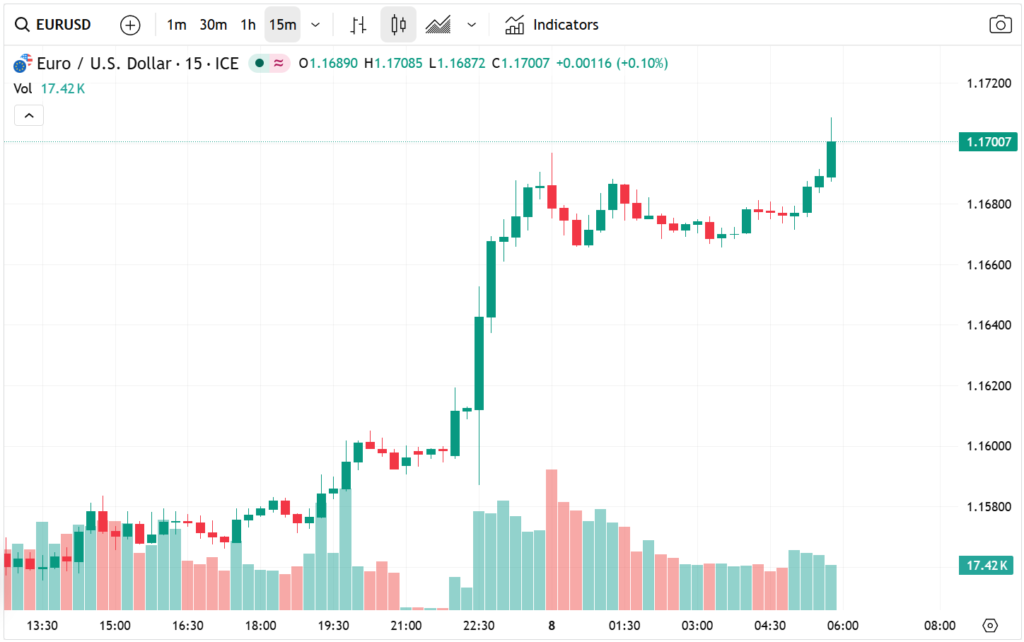
On the European side, traders are closely watching the upcoming services PMI data, particularly as economies reopen following the Easter holiday period. Economists forecast a decline from 51.9 to 50.5, indicating a near-stagnation scenario in the Eurozone services sector.
Additional key catalysts include US durable goods orders, which provide insight into business investment trends, as well as the release of the Federal Reserve meeting minutes, expected to offer deeper clarity on monetary policy direction, including inflation concerns and interest rate projections.
EUR/USD Technical Analysis
Trend Structure and Moving Averages
On the daily chart, EUR/USD continues to exhibit a consolidative structure within a broader downtrend. The pair remains below both the 50-day Exponential Moving Average (EMA) and the 100-day EMA, reinforcing bearish momentum.
Importantly, these two moving averages formed a mini death cross in March, a technical signal that often precedes extended downside movement.
Bearish Pennant Formation
A key technical feature currently in play is the formation of a bearish pennant pattern, a structure that typically signals potential continuation of a downward trend. This pattern consists of a sharp downward move (the flagpole), followed by a period of symmetrical triangle consolidation, where price action tightens before a possible breakout to the downside.
The converging trendlines of the triangle indicate volatility compression, suggesting that a breakout is imminent. Given the preceding trend was bearish, the probability favors a downward continuation.
Key Levels to Watch
Key Levels to Watch include the support level at 1.1413 (year-to-date low) and the resistance level at 1.1600 (critical invalidation zone). A confirmed break below the pennant support would likely trigger a move toward 1.1413, with potential for further downside if momentum accelerates. Conversely, a break above 1.1600 would invalidate the bearish scenario, opening the door for a short-term bullish reversal.
Conclusion
In summary, EUR/USD remains under downward pressure, constrained by both technical resistance and macro-geopolitical uncertainty. The formation of a bearish pennant pattern signals that a decisive move is approaching, with the balance of risks tilted toward a bearish continuation.
Traders should closely watch key support and resistance levels, as well as incoming economic data releases and geopolitical developments, which will ultimately determine the pair’s next directional move in the near term.


