
The Indian Rupee (INR) surged to an almost three-week high against the US Dollar (USD) in early Wednesday trading, following geopolitical developments and domestic monetary policy decisions. The USD/INR pair dropped to near 92.30, reflecting a weakening US Dollar and sharply lower global oil prices, triggered by a temporary US-Iran ceasefire. A complete breakdown of this subject is provided by the brokers at Fondesia in this article.
As of writing, the US Dollar Index (DXY), which tracks the Greenback against six major currencies, fell 0.55% to near 99.00, signaling broad-based weakness in the USD. Meanwhile, WTI crude oil prices plummeted nearly 11% to around $90.00 per barrel, alleviating some pressure on oil-importing economies such as India.
US-Iran Ceasefire Boosts Indian Rupee
Earlier, the US President announced via Truth Social that planned strikes on Iranian infrastructure targets, including power plants and bridges, were suspended for two weeks. The US cited Iran’s agreement for a “complete, immediate, and safe opening of the Strait of Hormuz,” a critical shipping route responsible for transporting nearly 20% of global oil supplies.
Iran outlined its 10-point plan, emphasizing controlled passage through the Strait of Hormuz under coordination with Iranian armed forces, an end to hostilities targeting Iran and its allied groups, the pullout of US combat troops from all regional bases, the removal of primary and secondary sanctions, full financial compensation to Iran, and the release of frozen Iranian assets.
Domestic Factors: RBI Maintains Status Quo
In its latest monetary policy review, the Reserve Bank of India (RBI) decided to maintain the status quo, keeping the Repo Rate unchanged at 5.25%. The decision was widely anticipated, as the ongoing Middle East conflict and volatile oil markets are expected to influence inflation dynamics.
RBI Governor Sanjay Malhotra emphasized in the policy statement that elevated crude oil prices, if prolonged, could increase imported inflation and widen the current account deficit (CAD). The central bank’s decision reflects a cautious approach, balancing the need for economic growth against price stability.
Despite the positive impact on the INR, the upside is partially capped by continued Foreign Institutional Investors (FIIs) selling in Indian equities. In April, FIIs have offloaded stakes worth Rs. 35,121.56 crore, exerting downward pressure on capital inflows and limiting currency appreciation.
Impact of Global Oil Prices on USD/INR Dynamics
The recent plunge in global oil prices, driven by the US-Iran ceasefire and the temporary reopening of the Strait of Hormuz, has had a pronounced effect on USD/INR volatility. India, as one of the world’s largest oil importers, benefits significantly from lower crude oil costs, which ease import bills and reduce pressure on the trade deficit.
Historically, USD/INR has shown an inverse correlation with oil prices: falling oil prices tend to strengthen the INR, while rising prices exacerbate inflationary pressures and weaken the currency. Analysts suggest that, if WTI and Brent crude maintain the current downtrend, the INR could sustain its near-term gains, provided FIIs flows stabilize, and geopolitical risks remain contained.
Technical Analysis: USD/INR Near-Term Outlook
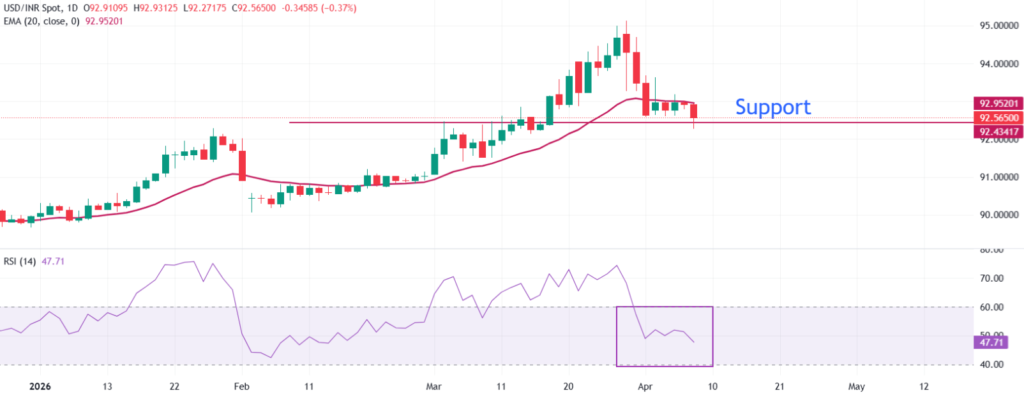
From a technical perspective, USD/INR remains under pressure, trading below its 20-day Exponential Moving Average (EMA), signaling a mildly bearish trend.
The 14-day Relative Strength Index (RSI) has declined to 47, falling below the 50 midline, confirming that sellers have gained momentum following overbought conditions above 70 in late March.
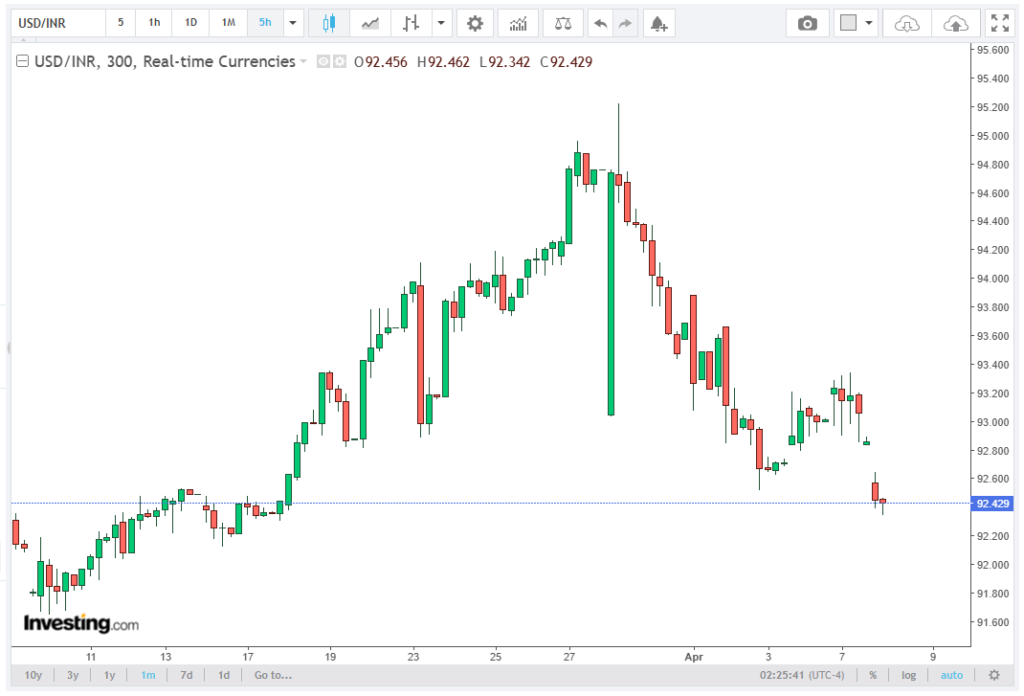
Key support levels are now observed at 92.00 and 91.50, corresponding to previous consolidation zones. On the upside, initial resistance is located at 93.00, with stronger barriers near 93.70, ahead of the recent peak at 95.12.
As long as USD/INR remains below these resistance levels and the RSI stays under 50, any rallies are expected to be short-lived and vulnerable to renewed selling pressure.
Market Implications
The combination of a US-Iran ceasefire and a steady RBI Repo Rate presents a favorable scenario for the INR. The weaker USD and falling oil prices are key positive drivers, while FIIs selling and potential oil price rebounds remain risk factors.
For importers, the currency strength reduces costs, while exporters may face minor headwinds due to a stronger INR. Forex traders should focus on technical levels, as the pair shows bearish momentum, while commodity-linked currencies like the INR are likely to benefit from lower crude prices.
In conclusion, the USD/INR movement is a confluence of geopolitical developments, domestic monetary policy, and technical factors. With the RBI holding the Repo Rate at 5.25% and the Strait of Hormuz reopening, the INR is poised for short-term strength. However, ongoing FIIs outflows and potential oil market volatility could cap further gains, making the near-term outlook cautiously optimistic.


