
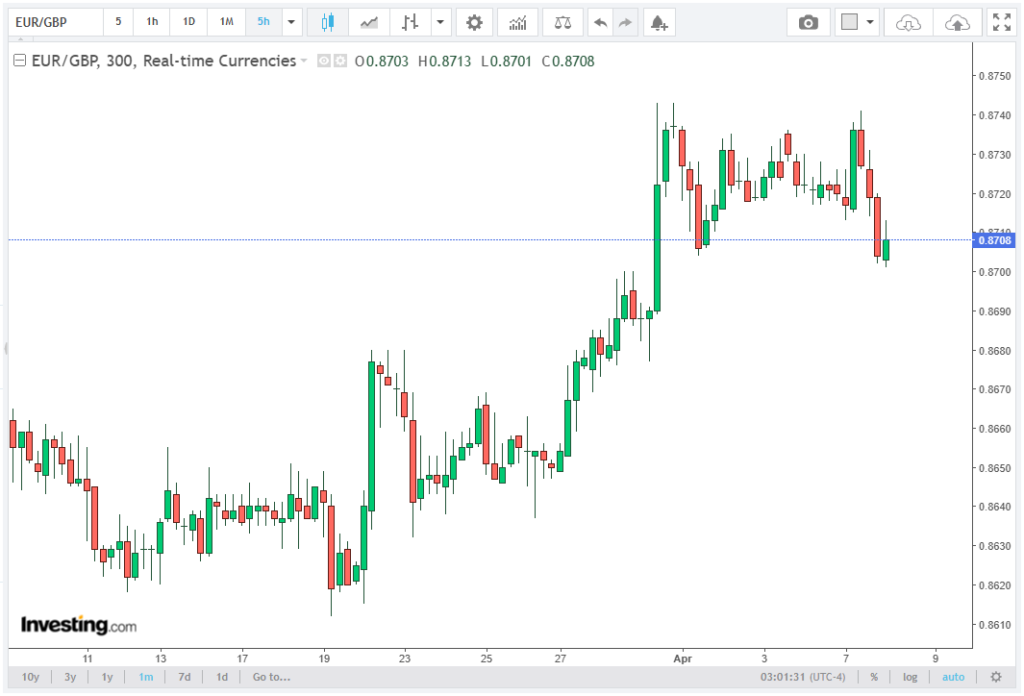
The EUR/GBP currency pair has weakened to around 0.8700 during the early European session on Wednesday, reflecting a combination of geopolitical developments, risk sentiment shifts, and monetary policy expectations. Fondesia’s brokers outline the key aspects of this topic in detail in the article.
Despite the Euro’s softening, the European Central Bank’s (ECB) hawkish guidance has provided a cushion, limiting further downside against the Pound Sterling (GBP).
Market Reaction to Geopolitical Developments
The decline in EUR/GBP has been influenced in part by improved global risk sentiment following a two-week ceasefire agreement between the United States (US) and Iran. The truce has led to expectations of reduced geopolitical risk in the Middle East, particularly around the strategically important Strait of Hormuz, which has implications for oil supply and energy markets.
The US President stated on his Truth Social account that Tuesday was “a big day for world peace,” highlighting that the US would be “helping with the traffic buildup” in the strait and that “big money will be made” as Iran begins reconstruction. Markets typically respond to such announcements with short-term risk-on sentiment, which tends to favor the GBP over the EUR, as the latter is more sensitive to risk aversion flows.
ECB Hawkish Tone Supports the Euro
While EUR/GBP has slipped slightly, the Euro has gained support from the European Central Bank’s (ECB) hawkish stance. ECB President Christine Lagarde emphasized that monetary policy will stay restrictive until inflation consistently aligns with the 2% target. This statement underscores the ECB’s commitment to containing price pressures, especially in the context of energy-driven inflation across the Eurozone.
Financial markets have responded to the ECB’s tone by pricing in 2–3 interest rate hikes in 2026, a notable shift from prior expectations of holding rates steady. This adjustment has helped cushion the Euro against the Pound, despite the short-term boost to GBP from improved risk appetite.
The ECB’s messaging underscores the central bank’s focus on inflation control, suggesting that any EUR weakness may be limited by anticipated monetary tightening.
BoE Policy and Sterling Dynamics
The Bank of England (BoE) has recently shifted from a bias toward cutting rates to a “wait-and-see” stance, signaling a more cautious approach amid domestic economic uncertainty. Current forecasts indicate that the Bank Rate is likely to remain unchanged at 3.75% for the remainder of the year.
According to a Reuters survey of economists, most have abandoned expectations for further rate cuts but have not fully embraced market expectations of nearly three rate hikes in 2026. This divergence between market pricing and analyst forecasts creates potential volatility in the GBP and, by extension, the EUR/GBP pair.
Despite the GBP’s short-term gains from easing geopolitical risks, the BoE’s cautious stance and the ECB’s hawkish tone collectively act as a counterbalance. This dynamic highlights the importance of monitoring both monetary policy signals and macro developments to assess near-term EUR/GBP trends.
Upcoming Eurozone Data
Traders are also eyeing Eurozone Retail Sales data, scheduled for release on Wednesday, as a potential catalyst for the EUR/GBP cross. Strong retail growth could reinforce expectations of a robust Eurozone economy, thereby supporting the EUR and limiting further declines against the GBP. Conversely, weaker-than-expected data could pressure the EUR, potentially pushing EUR/GBP below 0.8700.
Analysts highlight that EUR/GBP movements are increasingly driven by a combination of fundamentals and risk sentiment, rather than purely technical factors. As such, market participants are closely monitoring macro indicators, central bank statements, and geopolitical news flows to determine the cross’s trajectory.
Technical and Strategic Considerations
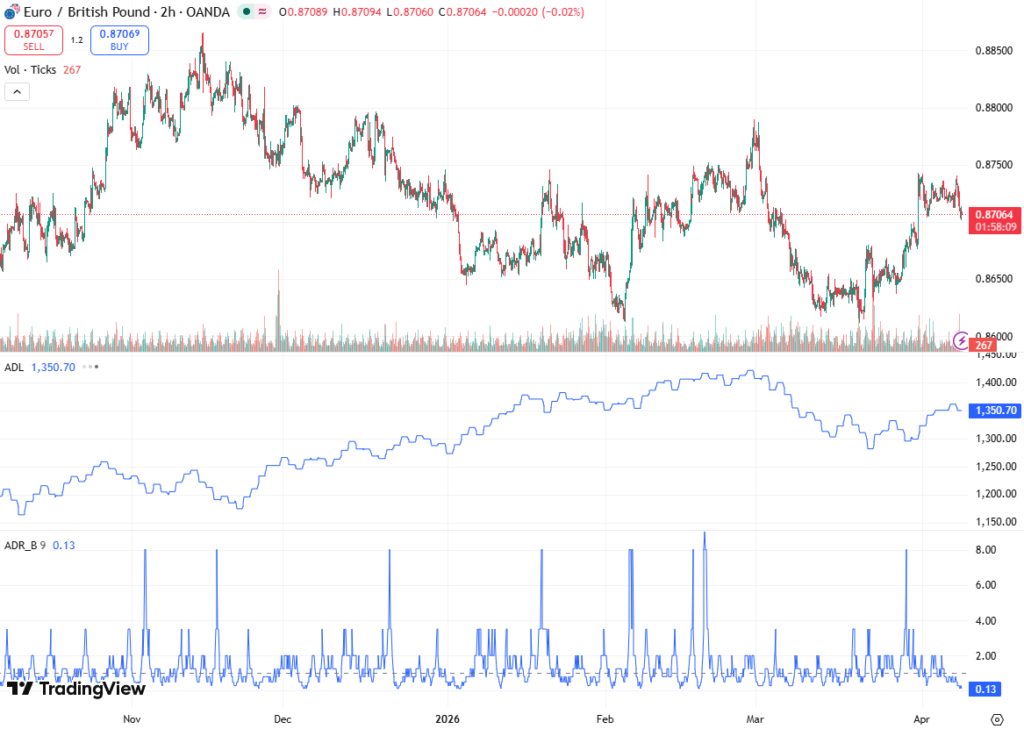
From a technical standpoint, EUR/GBP near 0.8700 represents a key psychological support level. A sustained break below this threshold could prompt further downside momentum, attracting short-term traders looking to capitalize on a weak Euro scenario.
Meanwhile, the ECB’s hawkish guidance and potential rate hikes may encourage long-term Euro bulls to re-enter positions, anticipating a reversal if the EUR strengthens against the GBP in the months ahead. Traders are therefore balancing short-term geopolitical gains for the GBP with medium-term monetary policy fundamentals supporting the EUR.
Conclusion
In summary, the EUR/GBP cross has edged lower to around 0.8700, influenced by improved risk sentiment following the US-Iran ceasefire and supportive comments from the US President. However, the Euro has found resilience thanks to the ECB’s hawkish tone, which signals ongoing monetary tightening and underpins the currency against the Pound Sterling.
With the BoE maintaining a neutral stance and the Eurozone Retail Sales looming, traders are navigating a delicate balance between geopolitical optimism and central bank fundamentals. The coming sessions are likely to see EUR/GBP fluctuate around this critical level, reflecting a mix of short-term risk sentiment and longer-term interest rate expectations.


