
The AUD/USD exchange rate stayed within a narrow range on Tuesday following key economic data from Australia. The pair recovered slightly to 0.6920, up from this month’s low of 0.6830, indicating cautious optimism among investors amid mixed economic signals.
However, the overall sentiment remains bearish, driven by weak domestic indicators and ongoing global uncertainties. This article features a comprehensive overview of the topic from the brokers at Fondesia.
Australian Economy Impacted by the Iran War
The AUD/USD pair traded sideways as investors absorbed the latest Australian macroeconomic data. S&P Global reported that the services Purchasing Managers’ Index (PMI) fell to 46.6 in March from 52.8 previously, indicating contraction in the services sector. The composite PMI also dropped sharply from 52.4 to 47, highlighting a broader economic slowdown.
This decline reflects the negative spillover from the ongoing war in Iran, which is contributing to rising inflation and heightened market uncertainty.
Weak Household Spending Adds Pressure
Further evidence of economic stress comes from household spending, which fell in February 2026. Year-on-year spending dropped from 4.6% in January to 4.2%, highlighting the strain of rising interest rates on consumers.
As borrowing costs increase, Australians may continue to reduce discretionary spending, putting additional downward pressure on retail sales, services demand, and ultimately economic growth. This trend adds to the bearish outlook for the AUD/USD pair, as investor confidence in the Australian economy weakens.
US Data and Federal Reserve Influence
The AUD/USD pair also fluctuated ahead of key US economic data, including durable goods orders. Economists forecast a contraction, with orders expected to drop from 0% in January to -0.5% in February.
Additionally, the Federal Reserve will release the minutes of its latest meeting on Wednesday, providing further insights into policy decisions. At the last meeting, officials chose to maintain interest rates between 3.50% and 3.75%. With inflation pressures persisting, markets now expect the Fed to keep rates unchanged for the remainder of 2026.
The upcoming Consumer Price Index (CPI) report is expected to show a rise to 3.4% in March, exceeding the Fed’s 2% target, which may influence future monetary policy. Additional US data this week, including GDP and Personal Consumption Expenditures (PCE) reports, could further impact AUD/USD volatility. Economists anticipate the fourth-quarter GDP to show 0.7% growth, a sharp deceleration from 4.4%, signaling a potential slower US economy.
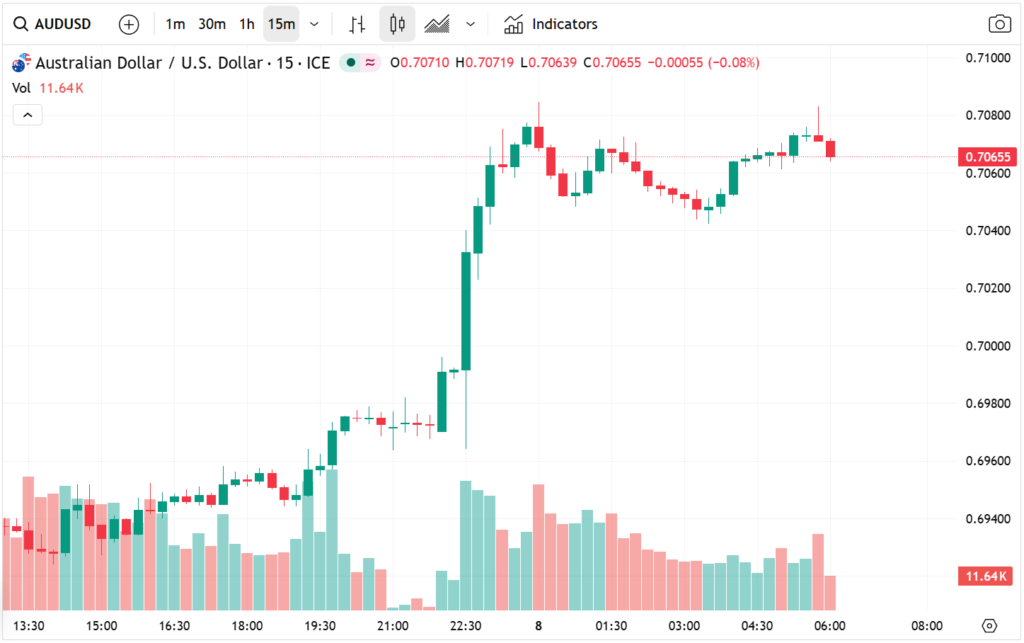
AUD/USD Technical Analysis
From a technical perspective, the daily timeframe chart reveals that the AUD/USD pair has experienced a sharp decline from the year-to-date high of 0.7185 in January to 0.6917, hovering just above the 23.6% Fibonacci retracement level. This retracement connects the highest and lowest levels since April 2025, highlighting critical support and resistance zones.
The pair has dropped below the 50-day Exponential Moving Average (EMA), signaling strong downward momentum. In addition, the Percentage Price Oscillator (PPO) has crossed under the zero line, further confirming the bearish trend.
Outlook for AUD/USD Amid Rising Global Uncertainty
The AUD/USD pair remains under pressure as Australian PMI and household spending weaken. Rising inflation and ongoing geopolitical tensions are weighing on the currency. The recent drop below the 50-day EMA and the PPO moving into negative territory reinforce the bearish momentum.
Upcoming US economic data, including GDP, CPI, and durable goods orders, could further influence the pair, keeping traders cautious and the AUD/USD outlook negative in the near term.
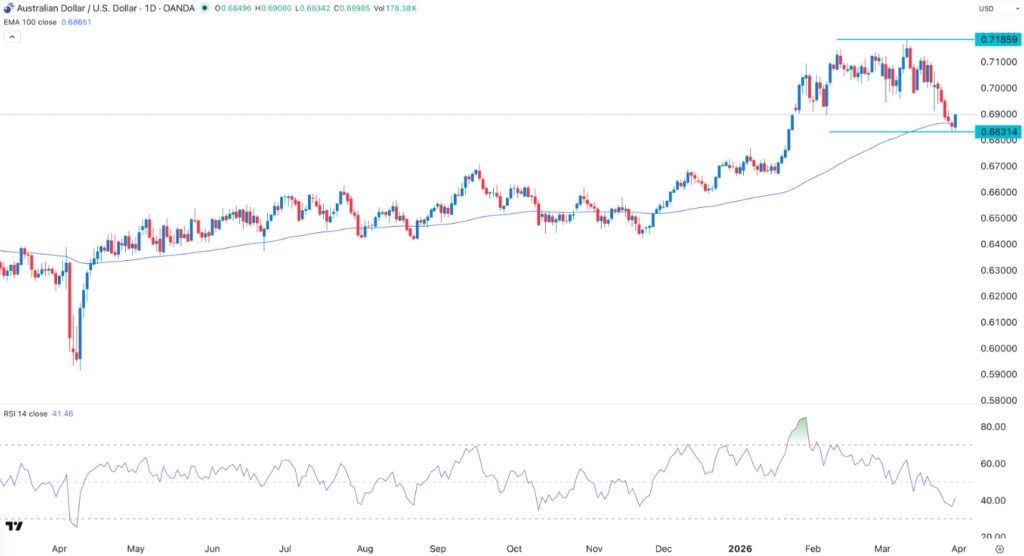
Key Support and Resistance Levels
Given the technical indicators, the AUD/USD is likely to continue its downtrend in the near term. The next key support level is around 0.6800, where buyers may step in. Conversely, a recovery above 0.7000 would invalidate the current bearish outlook, suggesting that market sentiment could shift.
Traders should monitor economic data releases, geopolitical developments, and US monetary policy closely, as these factors remain the primary drivers of short-term AUD/USD movements.
Conclusion
The AUD/USD pair remains under downward pressure, influenced by weak Australian PMI data, declining household spending, and persistent inflation concerns. Combined with ongoing geopolitical tensions and cautious US economic indicators, the market outlook remains bearish.
From a technical standpoint, the pair has breached key moving averages and momentum indicators, signaling further downside potential. Unless the AUD/USD climbs above 0.700, traders should expect the pair to test support near 0.6800, making the current market environment challenging for long positions.
Investors and forex traders should remain alert to the next round of economic data releases, particularly the US durable goods orders, CPI, and GDP reports, as well as any developments in geopolitical conflicts, all of which will continue to influence the AUD/USD exchange rate in the coming weeks.


