
The GBP/USD exchange rate remains under sustained pressure, hovering near its lowest level since December as intensifying geopolitical risks and macroeconomic uncertainty dominate market sentiment. In this article, the brokers at Fondesia present a thorough breakdown of the subject.
On Tuesday, the pair traded around 1.3240, marking a significant decline from its year-to-date high of 1.3865. This sharp pullback reflects a combination of risk aversion, US dollar strength, and weakening expectations for the UK economy.
Geopolitical Tensions and Market Impact
A major driver behind the recent GBP/USD weakness is the escalating conflict involving the United States and Iran. Market participants are particularly focused on developments tied to the US President, whose deadline regarding potential military action against Iran’s critical infrastructure has heightened uncertainty.
While tensions briefly eased following reports of a possible 45-day ceasefire negotiation, the situation remains fragile. Any escalation could trigger a surge in global energy prices, particularly Brent crude and West Texas Intermediate (WTI), which are already projected to rise toward $110 and $112, respectively.
Higher oil prices typically strengthen the US dollar due to its safe-haven status while simultaneously pressuring economies like the UK that are sensitive to energy import costs. This dynamic further exacerbates downside risks for GBP/USD.
UK Economic Indicators: PMI Data in Focus
On the domestic front, the British pound faces additional headwinds from weakening economic indicators. The upcoming UK composite and services PMI reports are expected to provide further insight into the health of the economy.
Economists forecast that the services PMI will decline from 53.9 in February to 51.2 in March, signaling a slowdown in the dominant sector of the UK economy. Similarly, the composite PMI is projected to fall from 53.7 to 51, indicating a broader loss of economic momentum.
This deceleration is partly attributed to the ripple effects of geopolitical instability. Industries such as aviation are already experiencing strain due to rising jet fuel costs and supply disruptions. These challenges could lead to reduced business activity, lower consumer confidence, and ultimately weaker economic growth.
US Economic Data and FOMC Minutes
On the US side, attention is turning to the upcoming release of the Federal Reserve meeting minutes, which will shed light on recent policy discussions within the Federal Reserve.
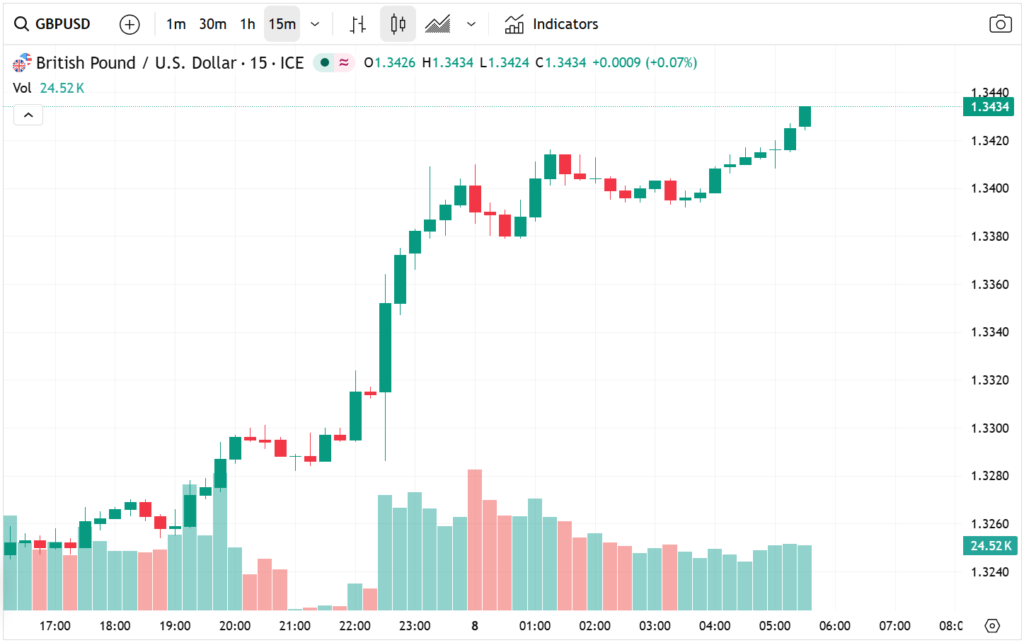
At its last meeting, the Fed opted to hold interest rates steady between 3.50% and 3.75%, reflecting a cautious stance amid mixed economic signals. However, recent data suggests that the US economy remains relatively resilient. The labor market added over 178,000 jobs in March, while the unemployment rate declined to 4.3%.
Additionally, investors are awaiting the latest Consumer Price Index (CPI) report, with expectations that headline inflation will rise to 3.4% from 2.4%. A higher-than-expected inflation reading could reinforce the Fed’s hawkish bias, supporting the US dollar and further weakening GBP/USD.
GBP/USD Technical Analysis
From a technical perspective, the GBP/USD pair continues to exhibit strong bearish characteristics. The daily chart highlights a consistent decline from the January high of 1.3874 to current levels near 1.3238.
A key development is the formation of a descending channel, which typically signals a continuation of downward momentum. The pair is also trading below the 50-day Exponential Moving Average (EMA), reinforcing the prevailing bearish trend.
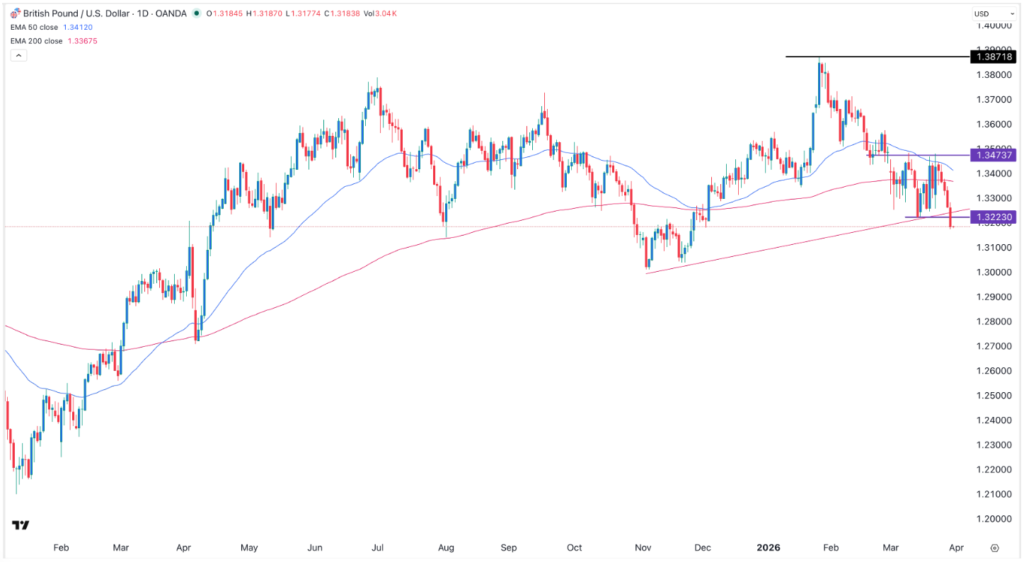
Further confirmation comes from the Murrey Math Lines, where the price has reached the Ultimate Support level, indicating limited immediate support below current levels. Additionally, the pair has broken beneath the Supertrend indicator, a widely used tool for identifying trend direction, suggesting that bearish control remains intact.
Key Levels and Outlook
Looking ahead, the next critical support level for GBP/USD lies at 1.3100, which represents a psychological and technical target for bearish traders. A break below this level could open the door for further declines toward lower support zones.
On the upside, a move above 1.3300, identified as the Weak, Stop & Reverse level, would invalidate the current bearish outlook and potentially signal a trend reversal. However, given the current macroeconomic and geopolitical backdrop, such a scenario appears less likely in the near term.
Conclusion
The GBP/USD pair remains under significant pressure as geopolitical tensions, weak UK economic data, and resilient US fundamentals converge to favor the US dollar. The formation of a descending channel, combined with bearish technical indicators, suggests that the pair is likely to continue its downward trajectory.
Traders should closely monitor upcoming UK PMI data, Federal Reserve minutes, and US inflation figures, as these events could act as key catalysts for the next major move. In the absence of a meaningful shift in fundamentals or sentiment, the path of least resistance for GBP/USD remains to the downside.


