
The technology sector is drawing renewed attention as Microsoft experiences a notable pullback from recent highs. The decline has raised some concerns among investors, particularly after a period of strong performance.
However, historical patterns suggest that such corrections are not uncommon in the tech space and do not necessarily point to long-term weakness, especially for companies with solid fundamentals and sustained growth drivers.
The current drop reflects a broader shift in market sentiment, particularly around technology valuations and growth expectations. One of the equity analysts at Uniglobe Capital notes that large-cap technology stocks often face periodic corrections, especially after extended periods of strong performance.
Rather than indicating structural issues, the recent decline may represent a reset in valuation levels, creating potential opportunities for long-term investors.
Significant Pullback Raises Investor Questions
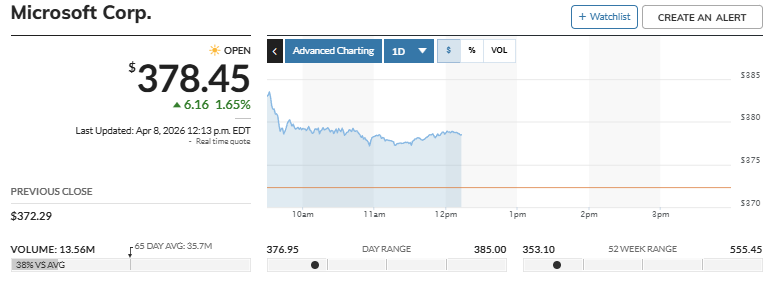
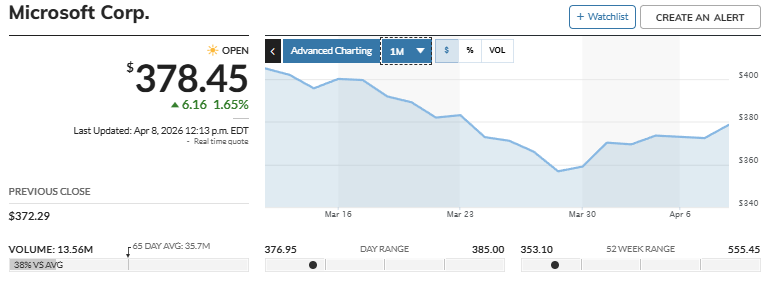
Microsoft shares have declined by more than 30% from their all-time highs, with losses exceeding 20% during the current year alone. This places the stock among the weaker performers within the large-cap technology segment over the period.
Such a decline can create uncertainty, particularly for investors who entered the market near peak levels. However, corrections of this magnitude are not uncommon in the technology sector, where valuation adjustments and market cycles often lead to sharp price movements.
Understanding the context behind the decline is essential in assessing its long-term implications.
Historical Patterns Suggest Recovery Potential
Looking at recent history, similar drawdowns have occurred under specific market conditions. Over the past decade, a comparable decline of around 30% happened during a period of heightened recession fears between 2022 and 2023.
Despite initial concerns, the downturn proved to be temporary. The company’s stock recovered throughout the following year, eventually reaching new all-time highs.
This pattern suggests that large-scale corrections do not necessarily reflect lasting weakness, particularly when underlying business fundamentals remain strong.
AI Spending Concerns May Be Overstated
Some of the recent weakness has been attributed to concerns around artificial intelligence investment cycles. However, the company remains deeply integrated into the AI ecosystem through its cloud services, which support a wide range of AI applications.
Rather than being negatively impacted, the business is positioned to benefit from increased demand for computing power and infrastructure. This suggests that concerns about AI-related spending may be overstated in the context of long-term growth.
The continued expansion of AI technologies is likely to support demand across key segments of the company’s operations.
Valuation Levels Approach More Attractive Range
The recent decline has brought valuation metrics closer to more attractive levels. From a price-to-earnings perspective, the stock is trading near its lowest range in the past decade, making it more appealing to long-term investors.
Lower valuations can provide a margin of safety, particularly for investors with a longer investment horizon. This shift may encourage renewed interest as market conditions stabilize.
At the same time, valuation alone is not the only factor, and investors continue to monitor broader market trends and company performance.
Institutional Buying Trends and Long-Term Positioning
Institutional investors often play a major role during periods of market correction, using price declines as opportunities to build or increase positions in fundamentally strong companies. Large asset managers and funds typically focus on long-term value rather than short-term volatility, which can lead to increased accumulation when valuations become more attractive.
This behavior can help stabilize prices over time and support gradual recovery. In addition, consistent inflows from retirement funds, index tracking portfolios, and long-term investment strategies contribute to sustained demand for established technology stocks. These structural buying patterns are important because they create a foundation of support even during uncertain market conditions.
As institutional participation remains steady, it reinforces confidence that strong companies can recover from temporary downturns and continue delivering value over extended investment horizons.
Market Sentiment And Forward Investment Outlook
The current environment reflects a balance between caution and opportunity. While some investors remain concerned about near-term volatility, others are viewing the pullback as a chance to accumulate positions at more attractive price levels.
Market sentiment can shift quickly, especially in the technology sector, where expectations and future growth projections heavily influence pricing. As conditions stabilize, investor confidence may gradually return, supporting a more constructive market environment.
This dynamic highlights the importance of balancing short-term risk with long-term potential, particularly during periods of uncertainty.
Looking ahead, the trajectory of the stock will depend on market conditions, earnings performance, and continued expansion in key segments such as cloud computing and AI infrastructure. If current fundamentals remain intact, there is a clear path toward gradual recovery over time.
The broader trend suggests that companies with diversified revenue streams, scalable business models, and strong market positioning are better equipped to navigate market cycles.
While uncertainty remains, the combination of historical resilience, improving valuation levels, and solid underlying fundamentals continues to provide a constructive and forward-looking outlook.


